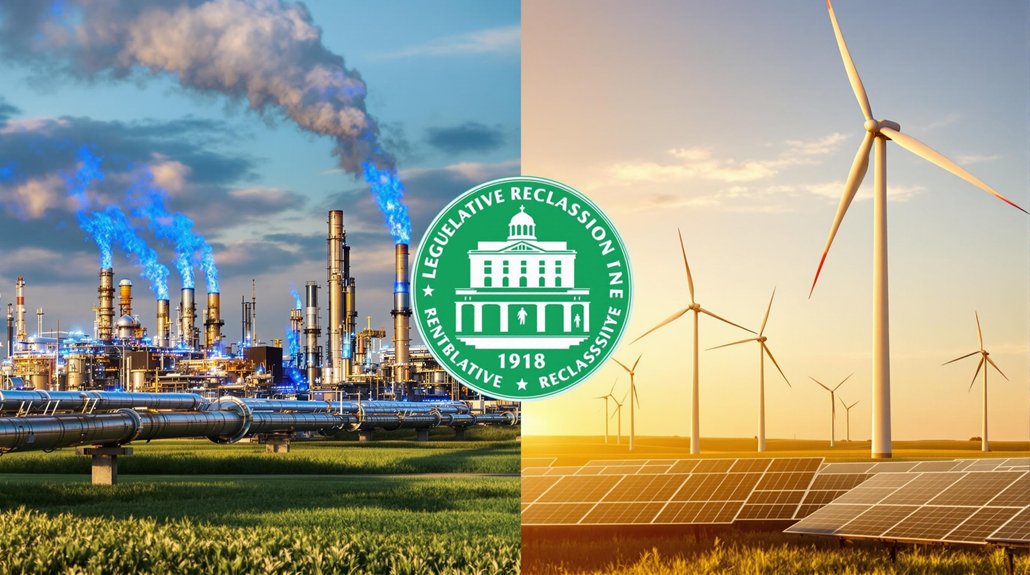
Indiana’s lawmakers recently passed Senate Bill 178, classifying natural gas and propane as “clean” energy sources. The decision has sparked heated debate across the state. Supporters claim the law will boost investment and help Indiana qualify for federal grants. Environmental groups strongly oppose the measure, arguing that methane from natural gas is far more harmful to the climate than carbon dioxide. The controversy raises important questions about what truly constitutes clean energy in today’s changing landscape.
While environmental groups raise concerns, Indiana lawmakers have passed Senate Bill 178, which officially classifies natural gas and propane as “clean energy” or “green energy” sources. The bill has passed both chambers of the legislature and now awaits the governor’s signature as of March 2025.
Senator Jim Buck, who authored the bill, modeled the legislation after a similar Ohio law passed in 2022. The main goal is to position Indiana to qualify for federal clean energy grants that could fund natural gas and propane projects across the state.
Supporters of the law believe it will help Indiana maximize its energy resources and attract more investments. The legislation aligns with broader efforts to support domestic energy markets and help companies meet Environmental, Social, and Governance (ESG) criteria.
However, environmental advocates are strongly opposing the new classification. They point out that natural gas produces methane, which is 28 times more potent than carbon dioxide as a greenhouse gas. While propane and natural gas generate lower emissions than coal, they’re not zero-emission sources.
Natural gas and propane may burn cleaner than coal, but they still contribute significantly to climate change through methane emissions.
The U.S. Department of Energy currently defines clean energy as sources that emit little to no greenhouse gases, such as solar, wind, hydro, geothermal, and nuclear power. Geothermal energy offers minimal greenhouse gas emissions while providing reliable power that isn’t affected by weather conditions. Most federal grant programs do not currently recognize natural gas and propane as clean energy sources, creating potential conflicts with Indiana’s new classifications.
“This reclassification undermines Indiana’s commitment to shifting to renewable energy,” say opponents of the bill, who prefer focusing on truly renewable alternatives like solar and wind power.
The debate highlights the tension between economic interests and environmental concerns. Indiana joins Ohio in adopting this controversial approach to energy classification, which could influence how the state approaches clean energy initiatives in the future.
The Indiana Department of Administration will oversee clean energy procurement policies for state entities under the new definition. The state already includes natural gas and propane-powered options in its definition of clean energy vehicles, but this law expands that classification more broadly across energy policy. The House lawmakers officially passed the bill on March 26, 2025, sending it to the governor’s desk for final approval.