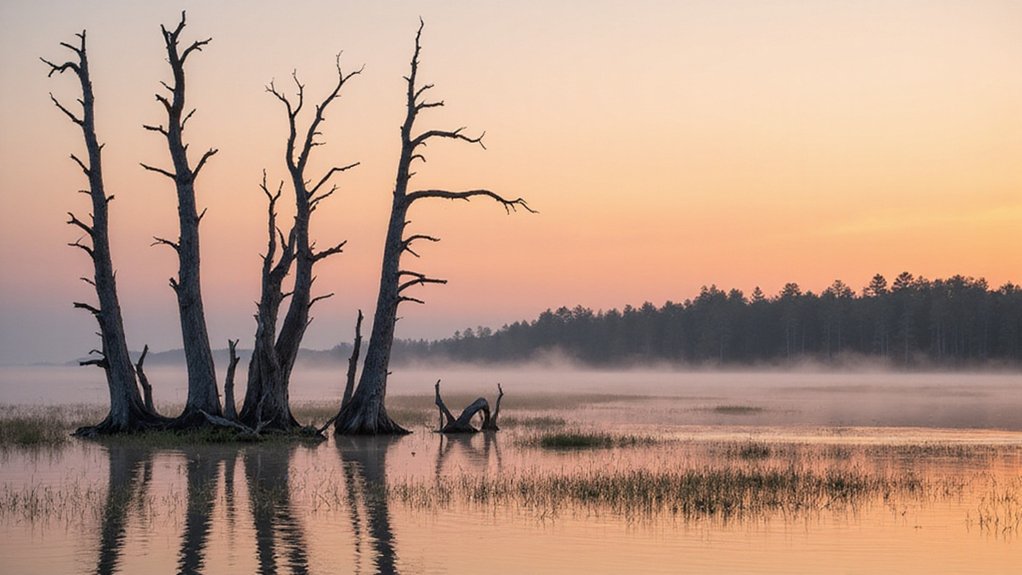
Along America’s eastern seaboard, forests are dying a silent death. Rising sea levels push saltwater into coastal woodlands, killing trees that can’t survive the salty soil. These “ghost forests” stand as pale sentinels, marking the ocean’s steady advance inland. Scientists have documented thousands of acres of dead trees from Florida to Maine. The shift isn’t just about losing trees – it’s changing entire ecosystems while communities nearby wonder what’s coming next for their homes and livelihoods.
As sea levels continue to rise around the world, coastal forests are facing an existential threat that’s transforming shorelines. These forests normally grow on low-lying land just above sea level, next to tidal marshes. But as ocean waters creep higher, saltwater is flooding these areas more often, killing trees and creating what scientists call “ghost forests” – eerie landscapes of dead, standing trees.
The process happens gradually but relentlessly. Rising seas push the boundary between land and water uphill, forcing forests to retreat as salt marshes move in. Salt-tolerant marsh plants, like smooth cordgrass, take root in the remains of dead trees. How quickly this happens depends on the steepness of the land. On flat coastal plains, even small sea level increases can affect large areas.
Nature’s slow-motion retreat: as waters rise, forests surrender ground to marshes in an unstoppable coastal reshuffling.
What’s killing these trees isn’t just flooding from above. Rising sea levels also push up groundwater tables below the surface. This creates waterlogged soils where tree roots can’t get enough oxygen. The saltwater that enters during high tides and storms adds stress that many tree species can’t tolerate. These effects can reach surprisingly far inland, affecting forests hundreds of meters from visible tidal zones.
The mid-Atlantic coast and southern New England are seeing widespread coastal forest dieback. Similar threats face mangrove forests in the western Pacific, which protect many island communities from storms and provide food and resources. This habitat destruction contributes to the biodiversity decline similar to what’s happening in dam-affected river ecosystems.
This transformation has serious consequences for both nature and people. As forests die off, they support fewer animals and plants. Ghost forests don’t provide the same habitat value as living ones. When forests convert to marshes or open water, they lose their ability to store carbon and buffer inland areas from storms.
Climate change is making the problem worse by intensifying storms, which push saltwater even further inland. Recent research from NC State University has shown that coastal areas below five meters experienced lower tree growth and higher mortality compared to higher elevation areas. The combination of gradual sea level rise and violent storms creates both chronic and acute stress for coastal forests.
For coastal communities, losing these natural barriers means increased vulnerability to flooding, erosion, and storm damage – a growing concern as climate change continues to reshape our coastlines.