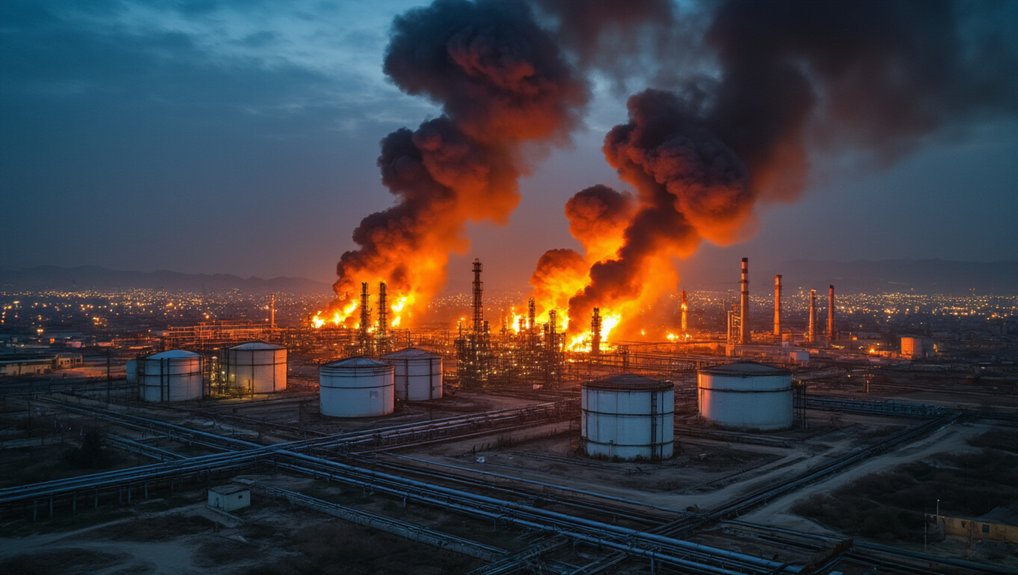

Israeli warplanes struck the heart of Iran’s energy infrastructure Thursday night, hitting oil depots and refineries that keep Tehran running. The precision strikes targeted the Shahran oil depot on Tehran’s northwestern outskirts, torching storage tanks that hold three days of fuel for the capital.
Down south, the massive Shahr Rey refinery got its own taste of Israeli firepower. The attacks didn’t stop there. Israeli jets hammered two natural gas refineries in Bushehr Province, a critical hub for Iran’s energy grid. Gas fields in the Persian Gulf took hits too, threatening export operations that keep Iran’s economy afloat. Well, whatever’s left of it anyway.
Israeli jets systematically pounded Iran’s energy infrastructure from Tehran to the Persian Gulf, crippling refineries and export operations.
Iranian officials rushed to claim they had the situation under control. Sure they did. The massive fires visible from miles away told a different story. Social media lit up with videos of Tehran residents forming long lines at gas stations, panic-buying fuel like it’s toilet paper in 2020.
This isn’t just about gasoline shortages. The strikes on gas processing infrastructure mean cascading problems for electricity production and industrial output. More blackouts are coming. Less heating for homes. Cooking? Good luck with that. Iran’s energy crisis, already bad, just got a whole lot worse. Iran’s ability to produce enough weapons-grade uranium for nine nuclear weapons within a month remains a critical concern, with the Fordow enrichment facility still operational despite the ongoing strikes. The country’s blackouts already cost the economy an estimated $250 million daily, and this attack will only deepen that hemorrhaging.
The Israelis weren’t just going after oil tanks. They systematically degraded Iranian air defenses and radar sites, including a military base in Piranshahr. Smart move – knock out the eyes before you go for the throat. Iran’s ability to detect and respond to future attacks? Compromised.
Global oil markets reacted predictably. Prices spiked. Traders got nervous. The risk premium on Middle Eastern crude jumped. Iranian businesses hoping to minimize financial impacts will face challenges as carbon offsets rarely provide tax benefits for companies operating in unstable regulatory environments. Every disruption to Iranian exports means tighter global supply and higher costs for everyone else.
History suggests what comes next. Energy disruptions in Iran have a nasty habit of sparking protests. The 2017 and 2018 demonstrations started over fuel prices and morphed into broader anti-government movements.
With fuel rationing likely and daily life getting harder, public confidence in the government’s ability to provide basic services is eroding fast.
References
- https://www.understandingwar.org/backgrounder/iran-update-special-report-june-15-2025-morning-edition
- https://www.worldoil.com/news/2025/6/13/israel-targets-energy-infrastructure-with-hit-on-iran-gas-field/
- https://www.youtube.com/watch?v=cgXGgFKJ8Wk
- https://digitalcommons.du.edu/cgi/viewcontent.cgi?article=3469&context=etd