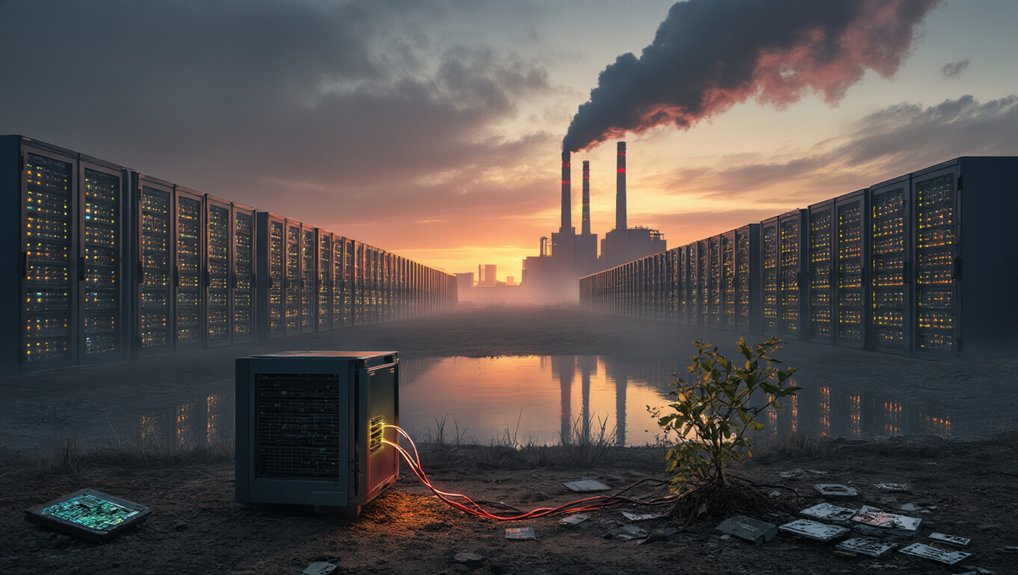
While tech companies tout AI as the solution to climate change, their data centers are quietly becoming environmental disasters. The numbers are staggering. By 2026, these facilities will consume 1,050 terawatt-hours annually—enough to rank fifth among entire nations in electricity use. That’s not a typo.
Here’s the twist: AI-driven demand will double the power needs of the Netherlands by late 2025. We’re talking 23 gigawatts versus the country’s 12.4. Nearly half of all data center energy will feed AI by year’s end. Computing power for AI doubles every 100 days. In five years, it’ll expand over a millionfold. Construction crews can’t build data centers fast enough.
But wait, it gets worse. Companies are playing games with their emissions reports. Actual emissions from AI data centers might be 7.62 times higher than what they’re telling us. That’s 662% higher, for those keeping score. Greenhouse gas emissions from these centers could hit 2.5 billion tonnes—40% of America’s current annual output.
Size matters, apparently. Larger AI models emit up to 50 times more carbon than smaller ones doing the same job. Smaller models get comparable results with just a quarter of the environmental damage. Yet companies keep building bigger models. Because bigger is better, right?
The renewable energy story isn’t much better. By decade’s end, AI will consume energy rivaling Japan’s entire output. Only half will come from renewables. Most data centers still run on fossil fuels. Green offsets? Pretty much useless when you’re burning coal. These facilities contribute significantly to the global emissions that experts are desperately trying to reduce through the clean energy transition.
Nobody talks about the hidden costs. Mining rare earth metals. Manufacturing chips. Shipping servers across oceans. Dumping outdated hardware in landfills. These lifecycle emissions get conveniently left out of corporate sustainability reports. Each data center also guzzles 2 liters of water per kilowatt hour for cooling—millions of gallons daily disappearing into vapor. Mid-sized facilities alone consume 300,000 gallons of water every single day.
Hardware upgrades happen constantly—AI demands the latest and greatest. Old servers become electronic waste.
Every ChatGPT query, every AI-generated image, every automated response carries this invisible burden. Tech companies promise AI will save the planet while their data centers help destroy it. The irony would be funny if it weren’t so depressing.
References
- https://news.mit.edu/2025/explained-generative-ai-environmental-impact-0117
- https://thesustainableagency.com/blog/environmental-impact-of-generative-ai/
- https://english.elpais.com/technology/2025-06-19/the-most-powerful-ai-models-emit-up-to-50-times-more-carbon-than-smaller-ones.html
- https://nationalcentreforai.jiscinvolve.org/wp/2025/05/02/artificial-intelligence-and-the-environment-putting-the-numbers-into-perspective/
- https://cacm.acm.org/news/the-carbon-footprint-of-artificial-intelligence/