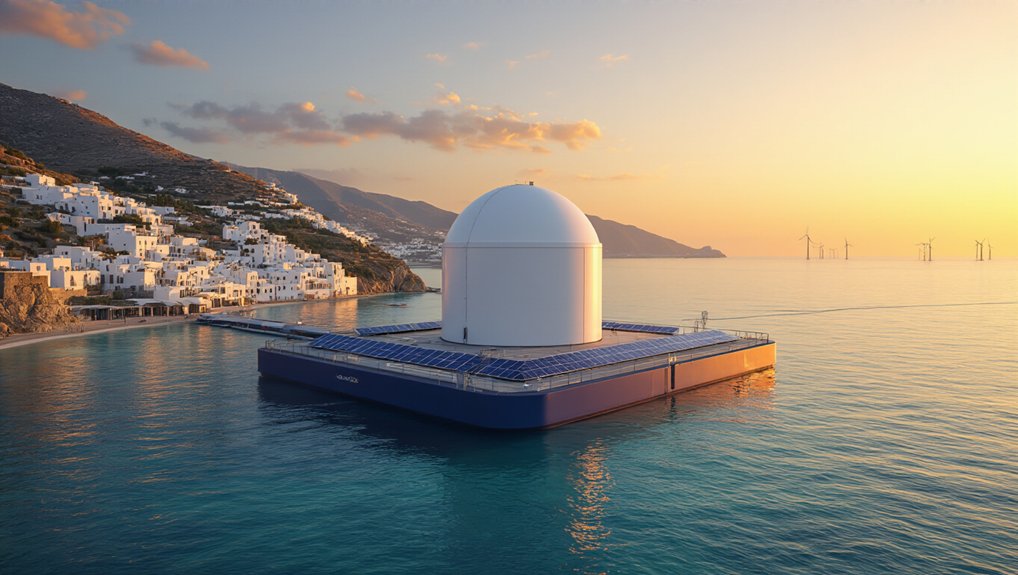

While most nuclear reactors are firmly planted on terra firma, a new wave of floating solutions is making waves in the energy sector. ABS, Core Power, and Athlos recently formed a consortium targeting Mediterranean islands, ports, and coastal communities with floating nuclear power plants (FNPPs). Not to be outdone, Westinghouse and CORE POWER are developing their own version featuring advanced microreactor technology. Because why build on land when you can float?
These floating reactors aren’t just cool tech toys. They deliver scalable, carbon-free electricity – exactly what these regions need to cut greenhouse gas emissions. Built in factories, containerized, and shipped to their destination, they’re like nuclear power in a box. Only the box floats. The standardized shipyard production slashes both costs and construction time. No more decade-long construction nightmares.
The technical specs are impressive. Using technology like the eVinci™ microreactor, these floating units can supply electricity to isolated communities or critical infrastructure. They’re designed with enhanced safety features specifically for maritime operation. And yes, they can be scaled up or down based on what the locals need. These designs incorporate walk-away safety concepts that make them resilient against external events without requiring operator intervention.
Islands and coastal towns are perfect candidates. Many struggle with limited grid connectivity and remain vulnerable to mainland energy disruptions. Prices spike? Storms knock out power lines? Not their problem anymore. The plants can even power desalination facilities and industrial ports – critical infrastructure in water-scarce Mediterranean regions. The consortium’s focus on the Mediterranean Sea region specifically targets areas with unique energy challenges faced by isolated communities. Unlike renewable technologies, these floating nuclear solutions don’t face the same intermittency and storage limitations that complicate full reliance on solar or wind power.
The economic impact could be substantial. These projects create jobs in shipbuilding, reactor servicing, and maritime logistics. Local economies benefit from reliable power, which attracts industries and supports residents. It’s cheaper too, with lower initial capital requirements than land-based reactors.
Regulation is actually simpler. Floating nuclear plants avoid many of the NIMBY battles and regulatory hurdles faced by land-based facilities. They’re subject to both nuclear and maritime safety standards, but previous projects in Russia and the US have already set precedents.
References
- https://maritime-innovations.com/mediterranean-floating-nuclear-power-plants/
- https://www.nucnet.org/news/new-consortium-to-evaluate-floating-nuclear-power-plants-for-mediterranean-7-5-2025
- https://highways.today/2024/12/03/floating-nuclear-plants/
- https://www.world-nuclear-news.org/articles/fnpps-to-be-evaluated-for-use-in-the-mediterranean
- https://www.nrc.gov/reading-rm/basic-ref/students/history-101/floating-nuclear-power-plants.html