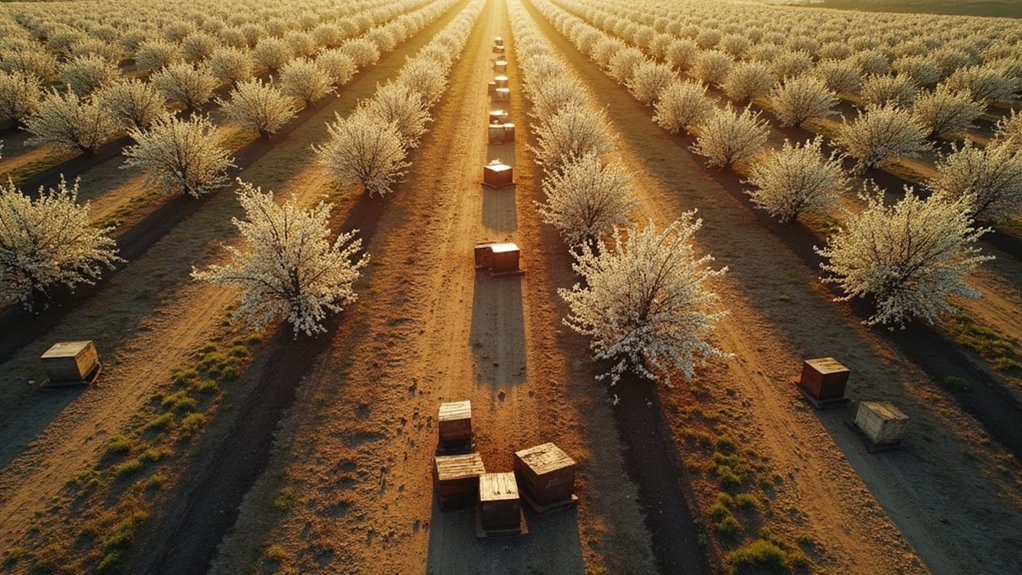

Nearly two-thirds of America’s commercial bee colonies have vanished in just eight months. The stats are brutal: 62% of commercial colonies gone between June 2024 and February 2025. Some experts think we’ll hit 70% by year’s end. Remember the great colony collapse of 2007? This is worse.
These aren’t just numbers. Over 1.1 million colonies reported dead already. Gone. Kaput. And while everyone’s playing detective, the usual suspects remain at large: Varroa mites, pesticides, poor nutrition, and viral diseases. It’s like honey bees are facing a perfect storm of everything terrible all at once.
The ripple effects are already spreading through agriculture. Honey bees pollinate everything from almonds to zucchini. Without them, crops fail. It’s that simple. About 35% of world food production depends on insect pollinators, with honey bees doing the heavy lifting.
Agriculture’s survival depends on bees. When they vanish, our food system collapses alongside them.
Some commercial beekeepers have lost nearly their entire operation – we’re talking 70–100% of their bees. Try running a business when all your employees suddenly vanish. The survey revealed that hobbyist beekeepers experienced 50% colony losses, showing that no operation size was spared in this crisis.
Financially, it’s a nightmare. The apiary industry has already lost over $139 million. Beekeepers are hemorrhaging money replacing colonies while facing higher operational costs. WSU entomologists have identified multiple stressors contributing simultaneously to this unprecedented decline. Honey production has tanked. And those almond orchards in California’s Central Valley? They’re sweating bullets.
What makes this particularly alarming is the context. Annual losses averaged 40–50% over the last decade – already unsustainable. Now we’re pushing 70%. It’s like watching a slow-motion train wreck suddenly accelerate.
The industry isn’t sitting idle. Major organizations like Project Apis m. and the American Beekeeping Federation have mobilized surveys to gather data. Beekeepers are trying new management strategies. Better monitoring techniques are emerging.
But honestly? It might be too little, too late. The bees are disappearing, and they’re taking our food security with them. Those little buzzing insects suddenly seem a lot more important when they’re gone, don’t they?
References
- https://honeybeehealthcoalition.org/survey-reveals-over-1-1-million-honey-bee-colonies-lost-raising-alarm-for-pollination-and-agriculture/
- https://abcnews.go.com/US/honey-bee-colonies-face-70-losses-2025-impacting/story?id=120191720
- https://www.avma.org/news/mass-honey-bee-collapse-may-compromise-us-agriculture
- https://theaggie.org/2025/05/30/following-massive-colony-loss-in-early-2025-new-methods-analyzing-temperature-data-help-beekeepers-predict-issues-in-the-hive/
- https://bees.wsu.edu/2025colonylosses/