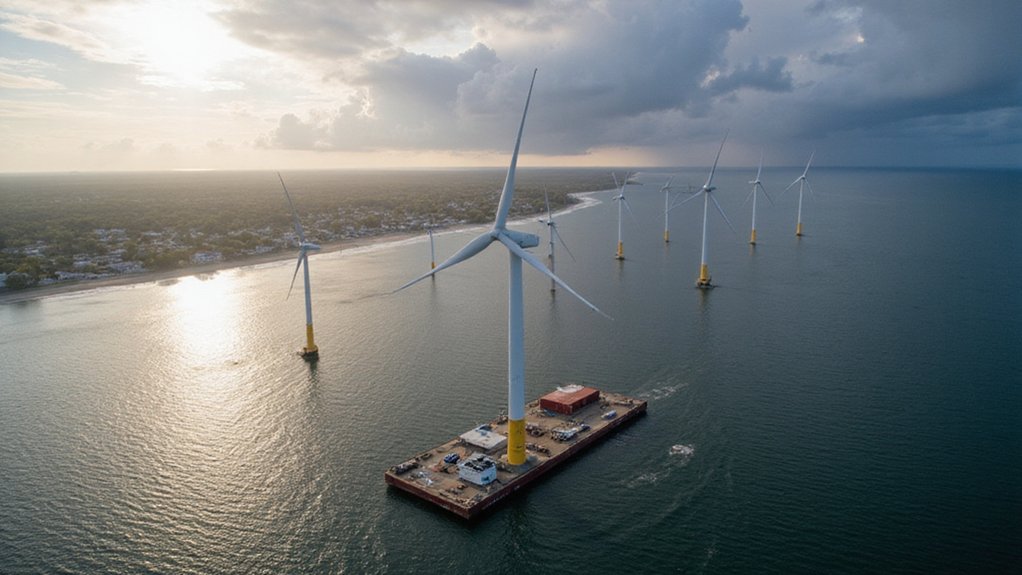

As the federal government ordered a halt to the nearly complete Transformation Wind project, governors from Rhode Island and Connecticut have publicly defied the directive, vowing to fight what they call an unjustified decision.
The governors condemned the federal order and promised to “pursue every avenue to reverse the decision,” suggesting potential legal battles ahead.
Governors vow to fight federal directive through all possible channels, setting stage for contentious legal confrontation.
The Change Wind project, which was 80% complete when construction was halted, was set to power over 350,000 homes across Rhode Island and Connecticut. Officials describe the project as essential for meeting state climate goals, especially given the limited land available for traditional energy development in New England.
Connecticut Senator Richard Blumenthal called the decision a “major setback” and joined state leaders in pledging to fight the federal directive. Commissioner Katie Dykes expressed deep disappointment but reaffirmed the states’ commitment to offshore wind development.
The halt has immediate economic impacts. Hundreds of skilled workers are now facing uncertainty, as the project had created significant union jobs in both states. The stop-work order threatens approximately 80 to 120 jobs at State Pier in New London where offshore components are being assembled.
Orsted, the project developer, is evaluating financial losses and considering legal action against the federal government.
Environmental groups and state officials have questioned the legal basis for the stop-work order. The Conservation Law Foundation noted the directive appears to lack proper legal foundation. Critics suggest the action shows bias toward coal plants over renewable energy sources.
The federal order represents a sharp policy reversal from the previous administration, which had approved multiple offshore wind projects. This shift has created tension between federal and state governments that had previously cooperated on renewable energy infrastructure.
Local officials emphasize that offshore wind is the “single most significant investment in clean, affordable energy” for the region. They warn that halting Change Wind risks higher energy costs and reduced grid reliability for New Englanders.
The setback comes at a time when the global renewable energy sector is experiencing unprecedented growth, with battery storage capacity nearly doubling nationwide to address intermittency concerns in renewable power generation.
The Bureau of Ocean Energy Management issued the halt order citing national security concerns related to wind turbine imports, threatening corrective action if Ørsted failed to comply.
Despite the federal obstacle, state leaders remain committed to their “all-of-the-above” energy strategies that include offshore wind development.
References
- https://www.ctpublic.org/news/2025-08-23/revolution-offshore-wind-stop-order-trump
- https://ctmirror.org/2025/08/23/revolution-wind-trump-administration-ct-offshore-wind/
- https://whatsupnewp.com/2025/08/trump-halts-construction-on-nearly-complete-revolution-wind-project/
- https://vineyardgazette.com/news/2025/08/23/construction-shut-down-wind-farm-aquinnah