While facing growing energy demands and security challenges, the U.S. Army has made significant strides in achieving energy independence through solar power. The Department of Defense set an ambitious target to deploy 1 gigawatt of renewable energy on Army installations by 2025, with a goal of deriving 25% of energy from renewables by the same year.
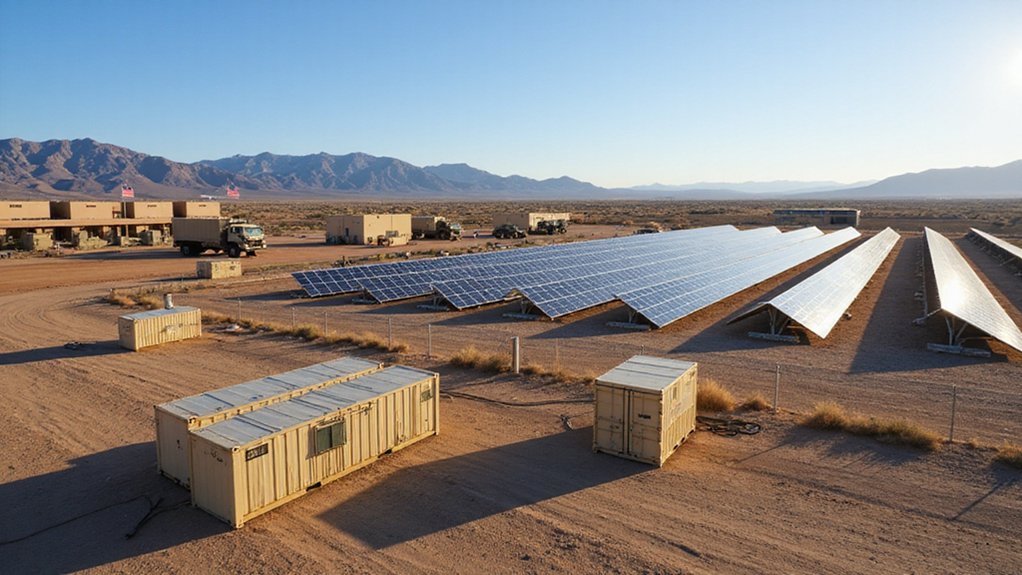
As of October 2018, the Army had installed 30 megawatts of solar capacity, eliminating 92,000 tons of carbon emissions annually. Energy offsets at four installations have already reached 30-60%, exceeding the 25% savings target ahead of schedule. More than 1,600 military homes now benefit from solar power, with 17,000 ground-mounted panels in operation across various bases.
The Army’s solar revolution is delivering ahead of schedule, with installations already exceeding renewable targets while powering thousands of military homes nationwide.
Fort Riley’s solar project, the largest in Kansas, offsets 33% of privatized housing energy consumption. The Army isn’t just installing solar panels; it’s integrating advanced microgrid technology for enhanced resilience and blackout protection. The Army aims to have microgrid installation completed at every Army installation by 2035. Battery energy storage systems have been deployed at various installations to provide backup power and improve grid stability.
These solar arrays guarantee critical operations continue during grid failures or disasters, decreasing vulnerability to external power failures and fuel supply disruptions. The reduction in supply convoys needed lowers exposure to risk, as previously one casualty was reported per 24 fuel resupply convoys. These initiatives also help address intermittency challenges that typically affect renewable energy sources like solar and wind.
Financial benefits are substantial. Solar projects deliver energy cost savings through long-term power purchase agreements, stabilizing rates for 25 years. These reduced utility costs allow the Army to reallocate funds to mission-essential services. The strategic partnership with Corvias and Onyx has been instrumental in facilitating these energy initiatives at competitive rates.
As the U.S. government’s largest energy consumer, the Army’s shift to renewables has significant environmental impact. Military solar projects reduce the carbon footprint equivalent to powering 2.6 million homes annually. This change aligns with federal sustainability mandates and positions the Army as a leader in green defense practices.
The Army continues to expand these initiatives, with plans for additional solar capacity and microgrids across more installations nationwide.
References
- https://www.smartenergydecisions.com/news/us-dod-heads-towards-2025-goals/
- https://pv-magazine-usa.com/2025/08/25/u-s-army-stays-course-on-mission-to-go-solar/
- https://seia.org/research-resources/solar-market-insight-report-q2-2025/
- https://pv-magazine-usa.com/2025/06/02/u-s-installs-4-4-gw-of-utility-scale-solar-in-q1-2025-retracting-about-30/
- https://8msolar.com/how-solar-power-is-redefining-military-operations/