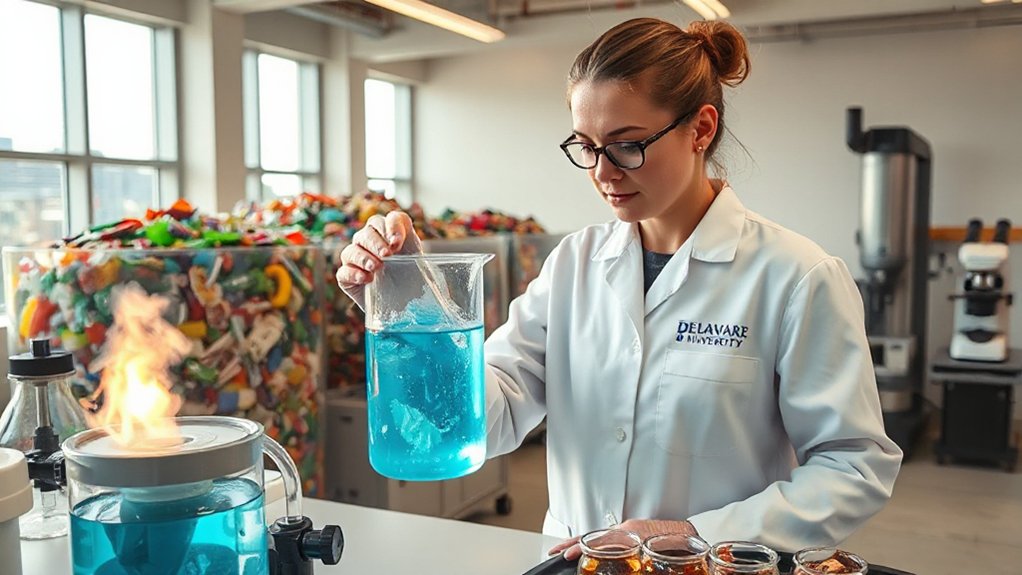
Every year, billions of plastic bags end up in landfills and oceans. Annoying, right? Well, scientists at the University of Delaware have developed something that might actually help. A new catalyst that converts plastic waste into liquid fuel using hydrogenolysis. Not just any catalyst—a supercharged one.
This isn’t your average recycling breakthrough. The team’s creation works nearly twice as fast as previous methods for processing low-density polyethylene (LDPE), the stuff your grocery bags are made of. They’ve engineered mesoporous MXene nanomaterials with larger pores, allowing molten plastic to move more freely across the catalyst surface. Science!
The real magic happens when ruthenium nanoparticles join the party. Stabilized on the MXene structure, they direct the chemical reaction toward producing liquid fuels instead of useless gases. Fancy.
Perhaps most impressive? This catalyst actually performs better when contaminated with PVC. Yeah, you read that right. While PVC normally ruins catalysts by releasing corrosive hydrogen chloride gas, this one thrives on it. Talk about turning lemons into lemonade—or rather, trash into gas.
The process happens in a pressurized reactor at high temperatures, efficiently breaking down polymers that were previously considered recycling nightmares. No sorting required. Just toss in your mixed plastic waste and watch the transformation.
Dump unsorted plastic nightmares into our hot reactor and witness chemical alchemy in action.
Environmental benefits are substantial. Less plastic pollution, reduced microplastics, and decreased reliance on fossil fuels. The team envisions a circular economy where yesterday’s shopping bags become tomorrow’s fuel. This innovation complements the growth of renewable energy sources which already provide 30% of global electricity.
This wasn’t a solo effort. Researchers from multiple institutions—University of Maryland, Oak Ridge National Laboratory, U.S. Army Research Laboratory, and NIST—collaborated on the project. The research was featured in the September 18 issue of Chem Catalysis journal.
Commercial applications are on the horizon as the team partners with industry players to scale up the technology. Senior author Dongxia Liu emphasizes upcycling plastics as a sustainable alternative to conventional waste management approaches. And oil companies? They might want to pay attention. A solution that’s economically viable and environmentally beneficial could disrupt traditional fuel markets. Sometimes trash really is treasure.
References
- https://www.udel.edu/udaily/2025/september/catalyst-speeds-plastic-waste-to-liquid-fuels/
- https://www.earth.com/news/energy-breakthrough-converts-plastic-waste-into-clean-fuels/
- https://scitechdaily.com/new-catalyst-could-make-plastic-recycling-a-whole-lot-less-complicated/
- https://bioengineer.org/transforming-plastic-waste-into-sustainable-fuel-a-breakthrough-innovation/
- https://www.packaging-gateway.com/research-reports/university-of-delaware-uses-catalytic-hydrocracking-for-hard-to-recycle-plastics/
- https://cpi.udel.edu/research-2-2/