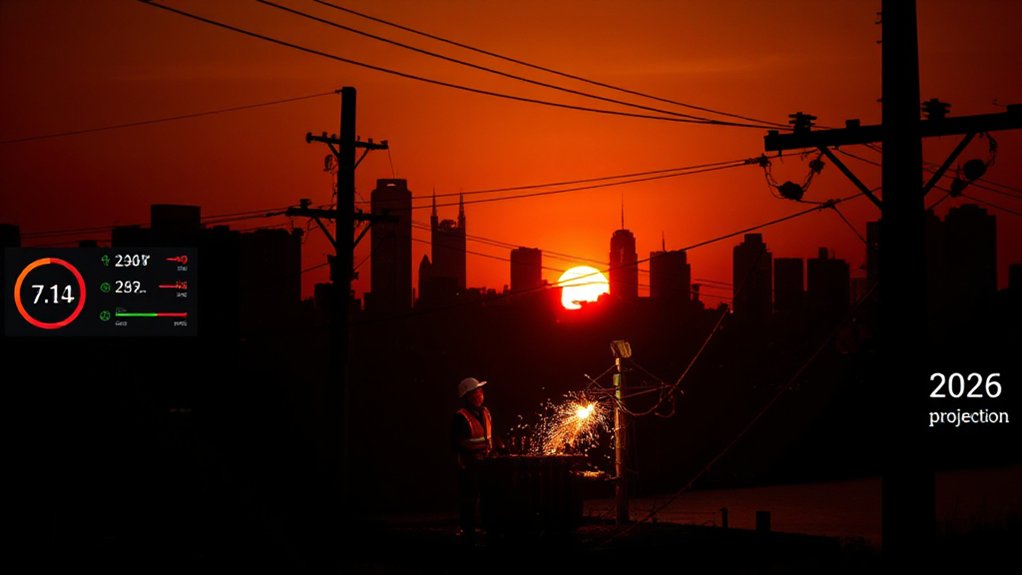

While New Yorkers worry about their next rent hike, a far bigger crisis looms just around the corner. The state’s power grid is headed for a serious breakdown starting summer 2026, according to alarming new assessments from the New York Independent System Operator (NYISO).
New York City will be first to face reliability violations, with Long Island following in 2027. The Lower Hudson Valley isn’t far behind, with its own power troubles expected by 2030. The margins are already “dangerously thin” in NYC. Great timing, right?
What’s causing this impending disaster? A perfect storm, really. Over 1,000 megawatts of capacity disappeared in May 2023 thanks to the state’s peaker rule limiting nitrogen oxide emissions. Another 590 MW will vanish by 2025.
Can’t breathe clean air without electricity either, but whatever.
The transmission system isn’t helping matters. NYC and Long Island are basically power islands, connected to the mainland by limited transmission lines.
And while the Champlain Hudson Power Express from Quebec should arrive by spring 2026, it’s like bringing a garden hose to a five-alarm fire. The severe drought conditions in Quebec further threaten the reliability of this hydropower source that New York is counting on.
Meanwhile, demand is skyrocketing. Data centers and semiconductor factories are popping up everywhere, gulping electricity like it’s free. These energy hogs are multiplying faster than new supply can be built.
The long-term picture? Even worse. An aging fleet of power plants, massive new electricity demands, and painfully slow development of new resources. Supply chain problems and rising costs aren’t helping. The anticipated loss of wind power will further strain an already weakened system.
The system needs thousands of megawatts of new generation within a decade.
NYISO isn’t just complaining. They’re evaluating solutions including new transmission projects, generation resources, and energy efficiency measures. The recently released transmission security analysis identifies serious deficiencies that must be addressed immediately.
But the clock is ticking.
References
- https://www.utilitydive.com/news/new-york-iso-warns-of-2026-reliability-violations-in-nyc-long-island/802699/
- https://www.publicpower.org/periodical/article/nyiso-planning-studies-highlight-grid-reliability-concerns
- https://www.nyiso.com/policymakers
- https://www.nyiso.com/-/press-release-nyiso-planning-studies-highlight-grid-reliability-concerns
- https://www.energycentral.com/energy-biz/post/ny-city-faces-grid-reliability-challenges-next-year-my-former-company-r15WOzDjNGgOMI3
- https://www.politico.com/newsletters/weekly-new-york-new-jersey-energy/2025/10/14/reliability-warning-flag-00606508
- https://www.canarymedia.com/articles/carbon-free-buildings/new-york-push-delay-gas-ban
- https://www.vitalcitynyc.org/articles/how-about-energy-affordability-for-new-york-city