While food delivery apps boomed during the pandemic years, the industry’s titans are staring down a perfect storm of problems in 2026. Labor woes top the list, with 54% of restaurant franchise leaders citing a shrinking labor pool as their biggest headache. No workers, no food. Simple math.
These labor shortages are driving operators straight into the arms of AI – not for companionship, mind you, but for help with scheduling and training. Meanwhile, 62% of restaurants have jacked up menu prices just to cover rising wages. Customers aren’t exactly thrilled about that.
With AI managing the kitchen schedule and menu prices soaring, neither robots nor customers are happy campers.
Speaking of unhappy customers – they’re increasingly judging restaurants solely on delivery experience rather than in-restaurant service. One soggy burger delivered late, and suddenly your five-star joint is getting trashed online. Tough break.
Food cost inflation blindsided the industry in 2025, hitting 91% of operators – higher than the 82% that had braced for impact. Add volatile fuel prices and new tariffs to the mix, and you’ve got a recipe for vanishing profits. Nearly half of businesses report feeling the squeeze from these tariffs. Ouch.
The economics are brutal. Marketplace commissions take a bite. Delivery costs take another. What’s left for the actual restaurant? Not much. That’s why dark kitchens and subscription models are spreading faster than delivery scooters on a Saturday night. Independent restaurants are finding it particularly difficult to absorb the rising ingredient costs compared to their chain counterparts.
Quality control becomes a nightmare once food leaves the restaurant. Temperature drops. Packaging fails. Fries get soggy. And who gets blamed? Not the courier who took a detour. The restaurant.
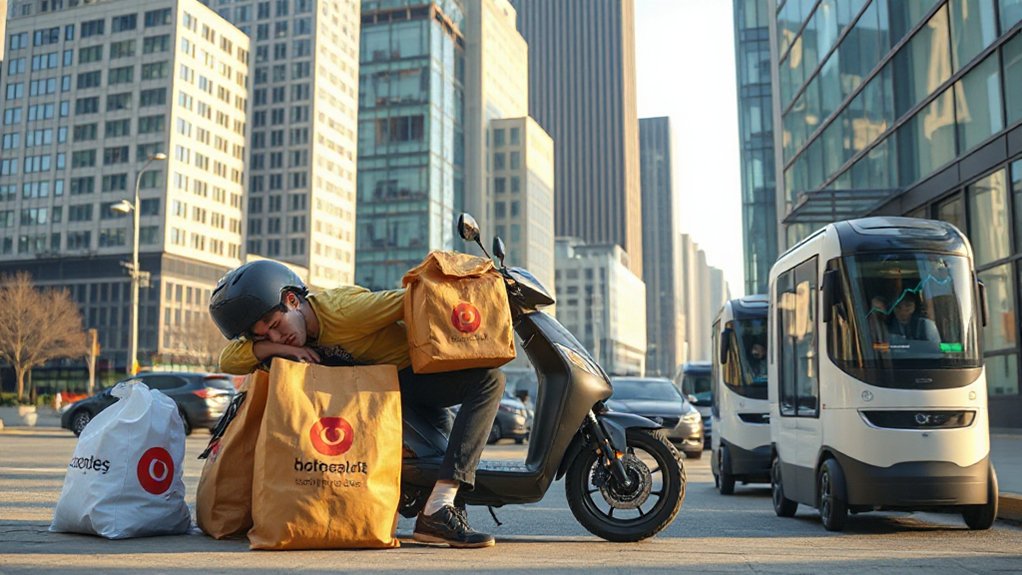
To top it all off, gig workers – the backbone of the delivery ecosystem – bring their own problems. Service quality varies wildly, and regulators are circling the gig economy like hungry sharks. Fast-casual global concepts are experiencing significant growth despite these delivery challenges. For an industry built on convenience, 2026 is shaping up to be anything but convenient. The move toward more environmentally conscious delivery options has also increased operational costs, with carbon footprint becoming a major concern for 68% of consumers.
References
- https://foodinstitute.com/focus/restaurants-3-key-challenges-for-2026/
- https://deonde.co/blog/top-8-challenges-faced-by-food-delivery-businesses/
- https://www.nrn.com/restaurant-labor/labor-shortages-dominate-restaurant-concerns-for-2026-but-ai-could-provide-relief-survey-says
- https://www.icoderzsolutions.com/blog/food-delivery-market-trends-and-scope-of-mobile-applications-in-food-business-by-2025/
- https://www.yoyumm.com/blog/online-food-delivery-industry-growth-trends-and-future-scope/
- https://businessjournaldaily.com/restaurant-survey-outlines-sales-cost-trends-shaping-2026/
- https://restauranttechnologynews.com/2025/12/what-restaurant-operators-actually-want-from-delivery-tech-in-2026/
- https://www.fastcasual.com/blogs/2026s-top-7-food-packaging-trends-revealed/
- https://www.qsrmagazine.com/story/6-ways-to-win-in-2026-a-restaurant-playbook-for-a-digital-first-world/