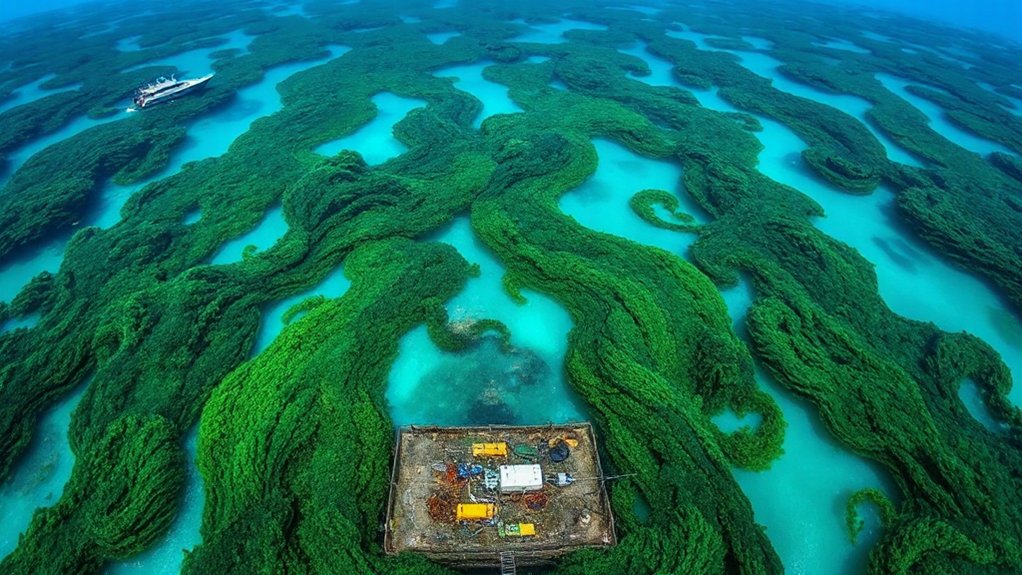

While most climate solutions seem to involve fancy technology or massive lifestyle changes, seaweed farms quietly work beneath the waves as unexpected carbon champions.
Scientists measuring carbon storage at 20 farms worldwide have discovered something remarkable: these underwater gardens are locking away carbon at rates that rival established blue carbon ecosystems like mangroves. Not bad for slimy sea plants.
The numbers are pretty stunning. Older farms store up to 140 metric tons of carbon per hectare in the sediments beneath them. That’s double the carbon found in nearby non-farm areas.
And here’s the kicker – the longer these farms exist, the better they get at trapping carbon. Farms operating for decades or even centuries (yes, some are 300 years old) show that this carbon stays locked away. No quick release. No take-backs.
We’re talking serious potential here. Current global seaweed farms sequester about 0.4 million tons of CO2 annually. Sounds impressive until you realize it’s just a drop in the ocean.
Ambitious expansion could remove up to 140 million tons yearly by 2050. To hit the really big leagues – capturing 1 billion tons annually – we’d need farm areas nearly twice the size of California. That’s… a lot of seaweed.
The mechanics are straightforward. Bits of seaweed break off, sink, and get buried in sediment. Over time, they’re pushed deeper into anoxic layers where decomposition slows to a crawl.
It’s nature’s version of “out of sight, out of mind,” except this time it’s actually useful.
Location matters, though. Farms in areas with naturally accumulating fine sediments trap more carbon. Not every coastal area is suitable.
Researchers utilized nuclear techniques to accurately measure carbon burial rates across the various seaweed farms in the study.
We’ve got to take into account shipping lanes, fisheries, and marine protected zones. But the potential is undeniable – a surprisingly simple solution hiding in plain sight.
The research, headed by Alexandra Cousteau’s Oceans 2050 initiative, represents a pivotal milestone for integrating seaweed farming into carbon markets.
Who would’ve thought seaweed could be such an overachiever?
References
- https://www.nature.org/content/dam/tnc/nature/en/documents/SeaweedMarketsAnalysis.pdf
- https://phys.org/news/2025-01-seaweed-farms-potential-carbon-storage.html
- http://www.iaea.org/newscenter/news/study-reveals-potential-of-seaweed-farms-as-carbon-storage-solution
- https://cleantechnica.com/2025/01/28/seaweed-farms-are-an-important-carbon-sequestration-strategy/
- https://oceanacidification.noaa.gov/funded-projects/carbon-capture-and-ocean-acidification-mitigation-potential-by-seaweed-farms-in-tropical-and-subtropical-coastal-environments/
- https://sustainability-accelerator.stanford.edu/farming-blue-carbon-modeling-seaweed-cultivation-marine-cdr-and-ocean-restoration