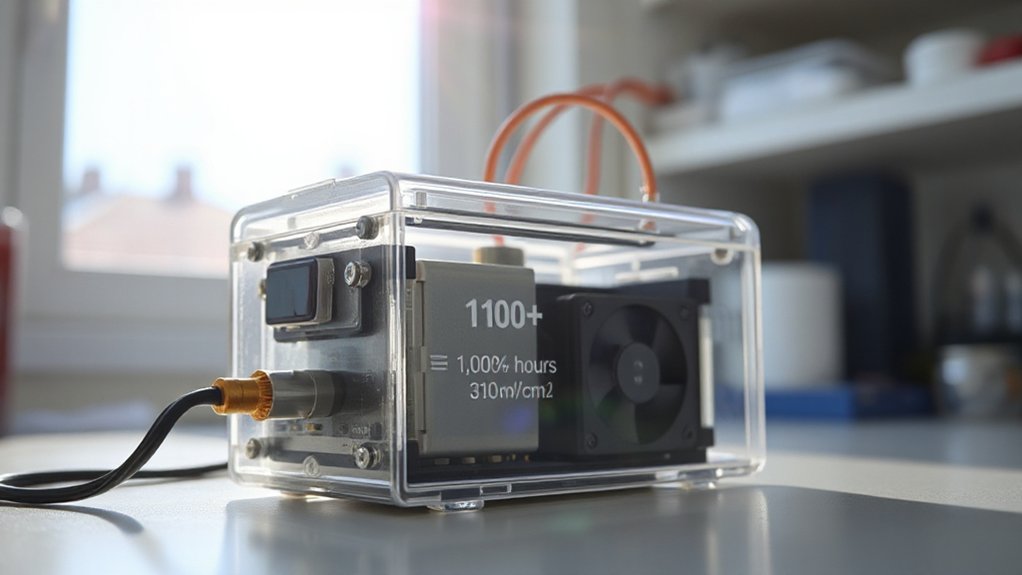

While traditional batteries continue to frustrate users with their limitations, a revolutionary sun-powered zinc-air battery has shattered performance records, achieving an impressive 310 mW cm⁻² power density under light exposure. This isn’t your grandpa’s double-A. The battery maintains stable charge-discharge for over 1,100 hours and delivers a whopping 96 W cm⁻² power density in flexible prototypes. Two months of continuous operation. No big deal.
The secret sauce? A p–n heterojunction with carbide and carbon naniber network, featuring dual cobalt active sites for bifunctional catalysis. Sounds complicated, right? It is. The design incorporates nitrogen-substituted graphdiyne as a photoelectrode and cobalt-iron atom pairs on nitrogen-doped carbon sheets. These components work together to inject photoelectrons into the conduction band—pretty slick engineering.
Light exposure transforms this battery’s performance. Charging voltage drops from 1.95 V to 1.36 V under illumination, achieving 90.4% energy efficiency and 30.3% energy saving. Photogenerated electrons speed up oxygen reduction while holes promote oxygen evolution. The result? Zero overpotential gap under illumination. That’s efficiency you can’t ignore.
Under sunlight, these batteries transform—dropping charging voltage while pushing efficiency to 90.4% with zero overpotential gap.
These batteries aren’t just powerful—they’re tough. The design promotes uniform current density, inhibits dendrite formation, and withstands repeated bending from 0° to 180°. Try doing that with your phone battery. This innovative technology leverages intrinsic safety advantages and abundant raw materials that traditional energy storage systems lack. The research team at Edith Cowan University has demonstrated that these advancements make zinc-air batteries viable for electric vehicles and aircraft. With a potential lifespan of 25-30 years similar to solar panels, these batteries represent a truly sustainable energy solution.
The hydrophobic electrolyte keeps water out, enabling 320 cycles and 1,600 hours of stable operation.
Compared to lithium? No contest. Zinc-air batteries offer lower cost, environmental friendliness, and higher safety with abundant resources. Lithium’s finite supply problem? Not an issue here.
Market outlook is equally impressive. The global market is projected to grow from USD 0.98 billion in 2026 to USD 2.10 billion by 2040—a 5.59% CAGR.
Applications range from grid-scale storage to wearable tech, solar-powered systems, and even electric vehicles. The USD 350 billion commercial-industrial market is ripe for disruption. Traditional power sources should be nervous. Very nervous.
References
- https://www.pnas.org/doi/10.1073/pnas.2318777121
- https://techxplore.com/news/2025-09-zinc-air-batteries.html
- https://interestingengineering.com/energy/zinc-air-battery-stable-performance
- https://www.sciencedaily.com/releases/2023/08/230821114338.htm
- https://www.abound.energy/zinc8-energy-advancing-innovative-battery-technology-that-uses-zinc-and-air-as-fuel/
- https://www.batterytechonline.com/battery-applications/zinc-air-batteries-still-a-contender
- https://www.rootsanalysis.com/zinc-air-battery-market
- https://www.newswise.com/articles/dual-site-catalysts-and-light-synergy-redefine-zinc-air-battery-efficiency
- https://www.azom.com/news.aspx?newsID=61785