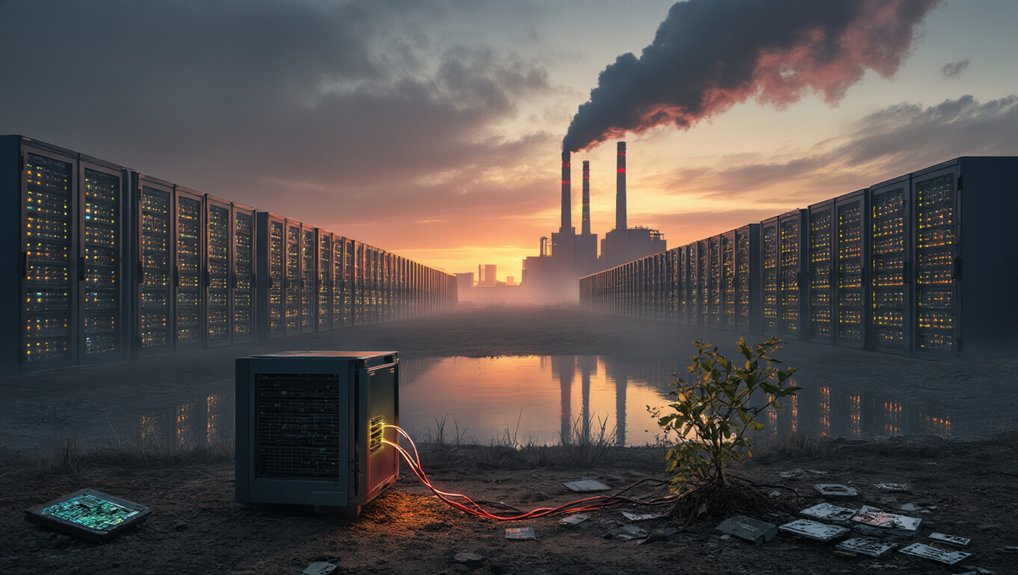
Behemoths of electricity. That’s what today’s AI data centers have become, gulping down 4.4% of America’s total electricity last year. And they’re just getting started. By 2028, these digital monsters could devour up to 12% of U.S. power. Not exactly a lightweight footprint.
Globally, the picture isn’t much prettier. Data centers worldwide are chomping through 415 terawatt-hours annually—1.5% of all electricity humans produce. And guess what? The U.S. is the biggest glutton at the table, responsible for nearly half of that consumption. China and Europe trail behind, picking up the scraps at 25% and 15% respectively.
Data centers are devouring 415 terawatt-hours globally, with America hogging almost half the power buffet.
The culprit? Generative AI. These fancy chatbots and image generators aren’t just cool party tricks—they’re power-hungry beasts that consume 10 to 30 times more energy than their simpler AI cousins. Training these models requires countless chips, each running hot enough to fry an egg. No wonder they need specialized liquid cooling systems just to keep from melting down.
These digital factories are now comparable to aluminum smelters in their energy appetites. Let that sink in. Tech companies are literally building their own gas power plants to feed the habit. A single AI data center can consume as much electricity as 100,000 homes combined. So much for those shiny net-zero pledges, right?
The environmental math doesn’t add up either. Data center emissions could balloon from 220 million tonnes of CO2 today to over 300 million by 2035. Climate goals? What climate goals?
To their credit, the tech giants aren’t completely oblivious. There’s a scramble to develop more efficient AI chips and optimize software. Major companies are making massive infrastructure investments totaling hundreds of billions of dollars to build advanced AI data centers across the globe. Some report reducing electricity per query—but training those massive models still guzzles power like there’s no tomorrow.
Even worse, these computational powerhouses create bad harmonics that disrupt normal electricity flow and can cause overheating in appliances up to 50 miles away. The question remains: will these computing giants transform from grid-straining gluttons into something more sustainable? Or will our AI-powered future require sacrificing our climate goals on the altar of digital progress? The clock’s ticking, and the meters keep spinning.
References
- https://www.americanactionforum.org/insight/ai-data-centers-why-are-they-so-energy-hungry/
- https://www.alerion.it/en/articles/the-hidden-cost-of-ai-the-energy-crisis-behind-the-digital-revolution/
- https://news.gatech.edu/news/2025/09/03/ais-ballooning-energy-consumption-puts-spotlight-data-center-efficiency
- https://www.carbonbrief.org/ai-five-charts-that-put-data-centre-energy-use-and-emissions-into-context/
- https://www.weforum.org/stories/2025/11/ai-accelerate-energy-transition/
- https://about.bnef.com/insights/commodities/power-for-ai-easier-said-than-built/
- https://aimagazine.com/news/ai-data-centres-will-drive-a-165-power-demand-explained
- https://www.nature.com/articles/d41586-025-00616-z