Silicon and soil are teaming up in ways farmers never imagined possible. Across the globe, artificial intelligence is transforming how we spot crop diseases—before they’re even visible to the human eye. It’s kind of a big deal. Traditional farmers who’ve spent decades squinting at leaves are suddenly finding themselves outperformed by algorithms.
The digital revolution in fields doesn’t wait for symptoms – algorithms now see crop diseases before farmers can even suspect them.
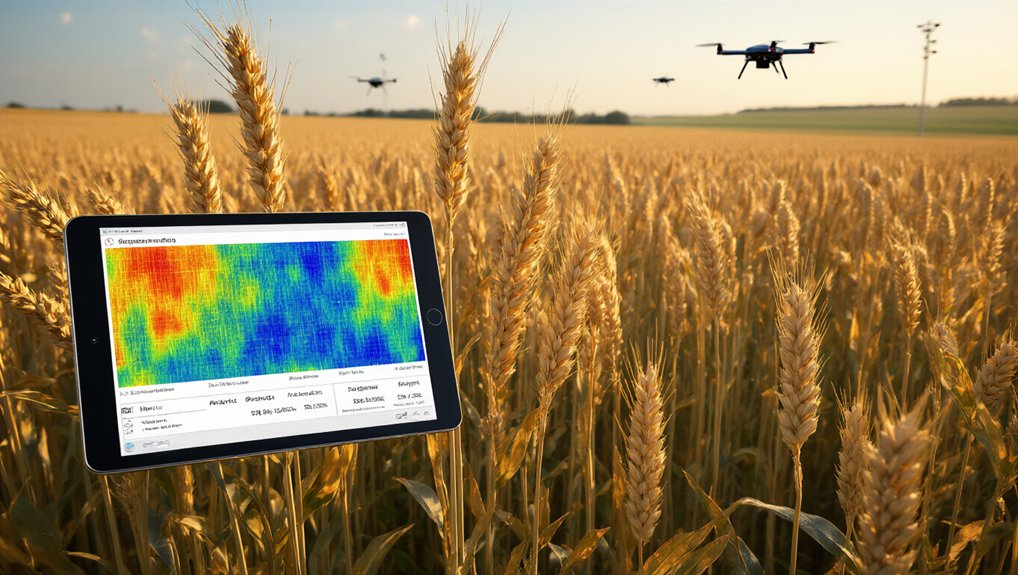
Here’s the thing: these AI systems aren’t just looking at regular photos. They’re using hyperspectral imaging that captures information beyond what humans can see. Diseases leave spectral fingerprints invisible to us but crystal clear to machines. Pretty wild, right? The technology can tell the difference between healthy wheat and wheat with stripe rust before symptoms are obvious. No human can do that.
The accuracy is frankly embarrassing for old-school methods. While Farmer Joe might spot disease when it’s already spread, AI platforms are hitting over 90% accuracy at early stages. That’s the difference between saving a crop and watching it die. The economic stakes are massive—plant diseases cost around $220 billion annually. That’s billion with a B.
You don’t need fancy equipment anymore either. Farmers can snap photos with their phones, upload them to cloud platforms, and get instant analysis. The AI does the heavy lifting, processing thousands of images while cross-referencing with satellite and weather data. Traditional inspection looks positively Stone Age by comparison.
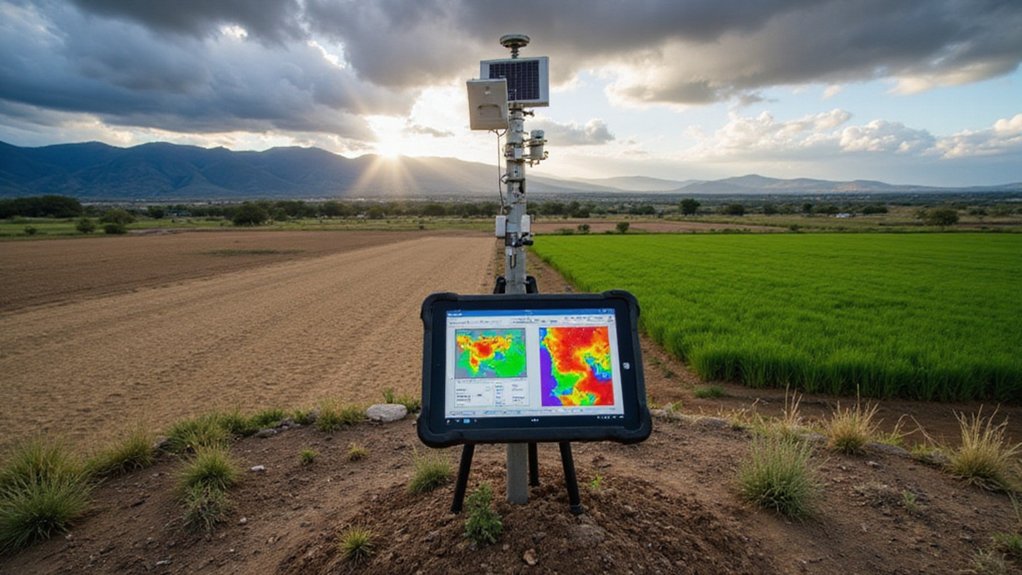
But it gets better. These systems aren’t just reactive—they’re predictive. Using historical patterns and real-time conditions, AI forecasts disease outbreaks before they happen. It’s like having a crystal ball for your cornfield. The integration of IoT devices throughout fields continuously feeds real-time data to these predictive systems, creating a comprehensive monitoring network. Advanced technologies like Vision Transformers are revolutionizing the field by capturing complex relationships within plant images that traditional models miss.
For countries where food security hangs by a thread, this isn’t just cool tech—it’s survival. The ability to detect and predict crop diseases across vast regions means fewer surprise catastrophes and more stable food supplies.
The future of farming isn’t just about bigger tractors. It’s about smarter ones. Traditional farmers are stunned, but they’re adapting. They have to.
References
- https://www.kaggle.com/competitions/beyond-visible-spectrum-ai-for-agriculture-2025
- https://dronelife.com/2025/03/18/ai-drones-and-the-future-of-farming-a-game-changer-for-plant-disease-detection-and-food-security/
- https://phys.org/news/2025-05-rooting-diseases-ready-farms.html
- https://www.dhs.gov/science-and-technology/news/2025/03/20/feature-article-plant-disease-detection-speed-commerce
- https://www.proag.com/news/ai-helps-detect-crop-disease/