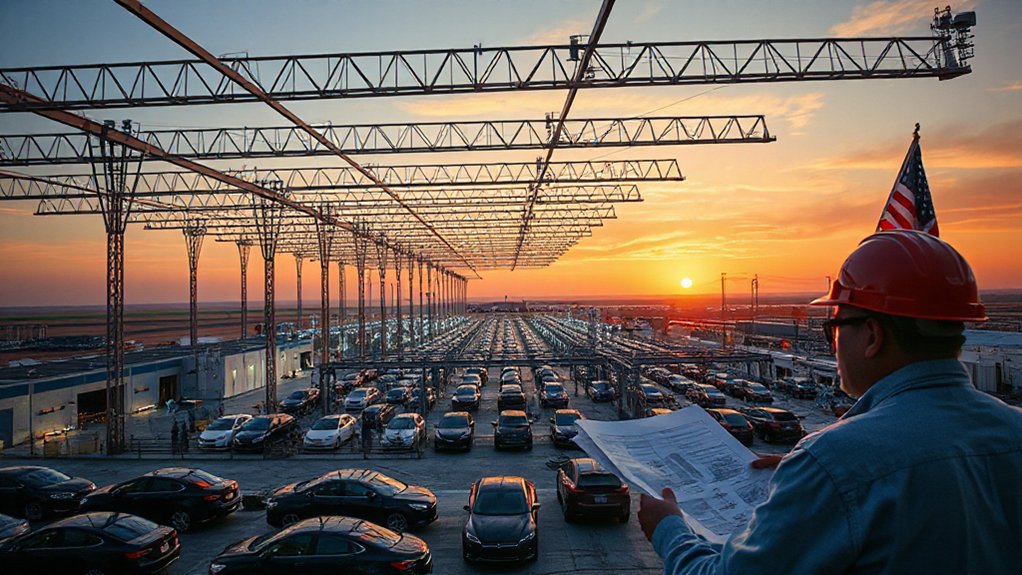

How exactly did Tesla go from zero manufacturing space to dominating the EV market in just over a decade? Simple. They built really big factories. Like, ridiculously big. Tesla expanded from nothing in 2009 to over 50 million square feet of manufacturing space by 2023. Not just buildings—gigafactories. Each one spans millions of square feet and churns out vehicles like nobody’s business.
The numbers don’t lie. Tesla delivered over 367,000 EVs globally in 2019, more than doubling what any competitor could manage. Fast forward to 2023, and they’re pushing 1.8 million units annually. Their Model 3 and Model Y alone grabbed a whopping 68% of the EV market share in early 2022. Ford’s Mustang Mach-E? Cute effort with 6,734 units, but Tesla’s Model 3 crushed it with 46,707 sales. Not even close.
Tesla doesn’t just lead the EV market—they absolutely dominate it with numbers that make competitors look like they’re still playing with toy cars.
Tesla’s vertical integration strategy is paying dividends. They control 80% of their supply chain, cutting production costs by 15% over two years. No middlemen, no problem. Their direct-to-consumer approach has California dealers crying over $700,000 in lost profit per location. Boo-hoo.
Legacy automakers are feeling the heat. Ford maintains 4,700 U.S. locations compared to Tesla’s 878, yet Tesla’s market cap per square foot makes them look like corner stores next to shopping malls. When chip shortages hit, traditional manufacturers slashed production while Tesla grew by 87% in 2021. Flexibility matters.
Not everything’s rosy for Tesla, though. BYD snatched the best-selling EV brand title in 2022 and widened the gap in 2023, selling over a million more EVs. Chinese automakers are exceeding ambitious EV targets alongside Tesla, creating genuine global competition. Like forests that absorb carbon dioxide, Tesla’s operations aim to create a more sustainable automotive future through carbon sequestration benefits in their manufacturing processes.
The gigafactory revolution continues with specialized facilities in Shanghai, Austin, and beyond. Shanghai serves Asia while Texas focuses on Cybertrucks and Model Y production. These gigafactories utilize in-house battery production to maintain Tesla’s competitive edge in the EV market. While Ford relies on traditional manufacturing methods established over a century ago, Tesla’s streamlined approach has created a massive industrial experiment that’s forcing every traditional automaker to rethink their entire approach. Too late for some of them.
References
- https://www.theijire.com/archiver/archives/teslas_impact_on_automobile_industry.pdf
- https://www.mmcginvest.com/post/legacy-vs-disruptor-ford-and-tesla-s-american-real-estate-footprints-compared
- https://eightception.com/tesla-vertical-integration-strategy/
- https://www.tesla.com/ns_videos/2019-tesla-impact-report.pdf
- https://www.tesla.com/ns_videos/2021-tesla-impact-report.pdf
- https://www.statista.com/topics/2086/tesla/
- https://www.tesla.com/ns_videos/2020-tesla-impact-report.pdf
- https://theicct.org/wp-content/uploads/2025/06/ID-371-–-GAR-2024-2025_report_final.pdf