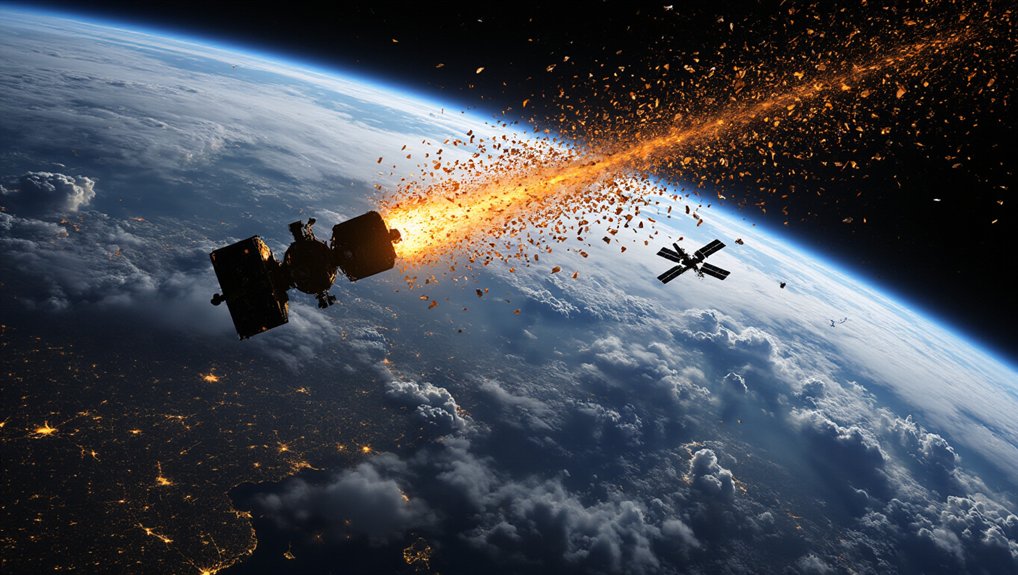

While Washington digs in its heels over who pays for what in orbit, space is turning into a cosmic junkyard. Thousands of dead satellites and debris fragments zip around Earth at bullet speeds. One collision could trigger a catastrophic chain reaction. But hey, at least Congress saved a few bucks on NASA’s budget.
The U.S. faces a stark reality. China and other rivals are racing to dominate the ultimate high ground while American politicians bicker over funding. Current space regulations? They’re dinosaurs, written for an era when launching anything cost more than a small country’s GDP.
Now SpaceX and others have slashed costs so dramatically that everyone and their mother wants to launch satellites. Here’s the twist: those mega-constellations everyone loves for internet access? They’re cramming low Earth orbit like a rush-hour subway. Thousands more satellites are coming. Nobody’s really tracking all the junk up there effectively.
The tech for cleaning up space debris barely exists beyond PowerPoint presentations and lab experiments. Meanwhile, the Pentagon finally figured out what everyone else knew for years – space isn’t peaceful anymore. It’s a warfighting domain. Even as threats mount, the DOD’s trillion-dollar budget faces pushback from Senate and House Armed Services Committee leaders who call it inadequate for maintaining space dominance.
GPS satellites that guide everything from Uber drivers to precision bombs? They’re sitting ducks. Communication satellites keeping soldiers connected? Prime targets. America’s rivals aren’t just watching. They’re building weapons.
The private sector wants in on the action, but outdated rules strangle innovation. FAA regulations create barriers that hamper growth while SpaceX and Rocket Lab develop reusable rockets that could revolutionize access to orbit. Companies that could help track debris or strengthen America’s position get tangled in red tape while competitors overseas charge ahead. Makes perfect sense, right?
Time’s running out. The U.S. needs enforceable frameworks for managing space traffic before LEO becomes completely unusable. International cooperation sounds nice, but America must lead by example.
Set the standards. Build the systems. Make the rules. Otherwise, when that cascade of collisions starts – and experts say it’s when, not if – the country that put humans on the moon will be locked out of space entirely.
The orbital commons determine who controls the future. America better claim its stake before it’s too late.
References
- https://csps.aerospace.org/sites/default/files/2024-10/SpaceAgenda2025_Compilation_Web.pdf
- https://www.akingump.com/a/web/oUzWYdTEN1SggbS46KmBo/arfmoo/space-law-regulation-and-policy-update-june-2-2025.pdf
- https://spacepolicyonline.com/news/whats-happening-in-space-policy-may-4-10-2025/
- https://manhattan.institute/article/us-space-policy-the-next-frontier
- https://aerospace.org/article/aerospaces-csps-highlights-what-us-leaders-need-know-space-agenda-2025