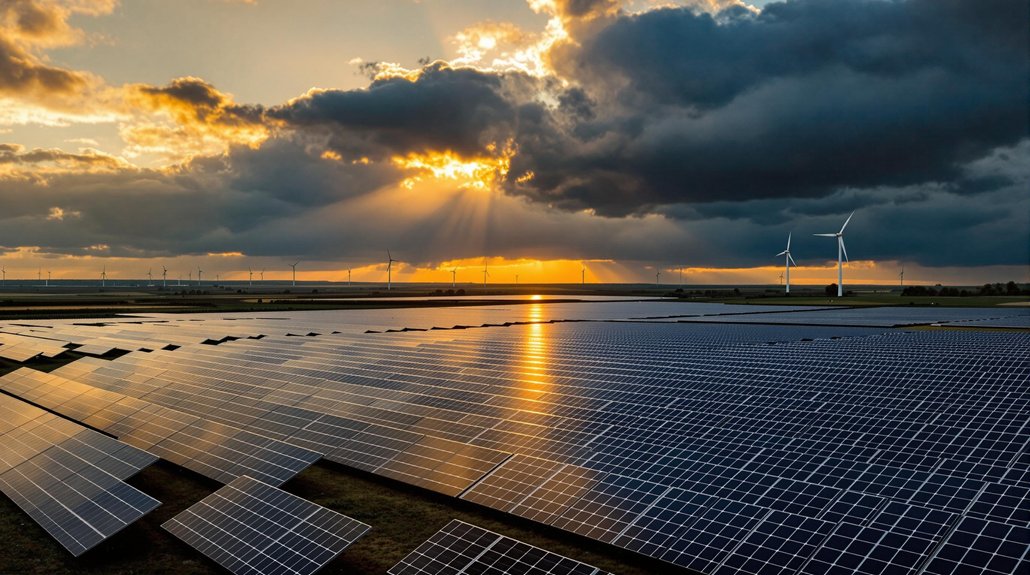
While the United States is installing solar panels at a record-breaking pace, the boom may not last much longer. The federal tax credit that helps homeowners pay for rooftop solar is set to shrink after 2025. That change could slow down one of the fastest-growing energy sources in the country.
Right now, solar dominates new power generation in America. It made up 75% of the 28 gigawatts of new electricity capacity added in 2025. Wind accounted for 13%, and natural gas contributed 11%. Solar has become the second-largest source of generation capacity in the nation.
The numbers tell a dramatic growth story. In 2024, the U.S. installed 36.2 gigawatts of solar, a 34% jump from the year before. Solar generation grew 27% that same year. Solar and wind together produced a record 756,621 gigawatt-hours in 2024, tripling their output from 2015.
Texas has emerged as the country’s solar leader. It hosted 27% of 2025’s solar additions and surpassed California as the top state for utility-scale solar capacity in 2024. Together, California and Texas generated 41% of all U.S. solar power last year.
But not all segments are thriving equally. Utility-scale solar surged 60% in 2024 to 30.6 gigawatts. Residential solar, however, fell 39% to just 3.9 gigawatts. That sharp drop in home installations signals trouble ahead. If the federal tax credit for homeowners decreases in 2026, rooftop solar could decline even further. Meanwhile, the Trump administration has criticized renewable energy as unreliable and expensive, and the signing of the One Big Beautiful Bill Act further impacts renewable energy tax credits.
The solar industry’s revenue hit $40.6 billion by the end of 2025, up 39.3% that year. It’s grown at an average annual rate of 28.7% since 2020. The Energy Information Administration projects 39 gigawatts of solar in 2025 and 36 gigawatts in 2026. Analysts expect solar additions to peak around 2028. Despite the industry’s rapid expansion, the competition level is moderate and increasing as new players enter the market alongside established companies. In 2023 alone, 3.4 million families claimed $8 billion in clean energy credits, underscoring how deeply these incentives have become embedded in household energy decisions.
Looking further ahead, 91 gigawatts of solar sit in high-probability development queues through September 2028. That’s 67% of all planned additions. U.S. installed capacity is projected to increase 57% by 2050, driven largely by solar.
The utility-scale side of solar isn’t going anywhere soon. But for everyday homeowners, the window to go solar with maximum federal support is closing fast.
References
- https://www.utilitydive.com/news/solar-gas-nuclear-ferc-infrastructure-report/807053/
- https://www.eia.gov/todayinenergy/detail.php?id=65964
- https://docs.nrel.gov/docs/fy25osti/95135.pdf
- https://www.ibisworld.com/united-states/industry/solar-power/1914/
- https://seia.org/research-resources/solar-market-insight-report-q4-2025/
- https://www.climatecentral.org/climate-matters/solar-and-wind-2025
- https://seia.org/research-resources/solar-market-insight-report-q3-2025/
- https://www.altuspower.com/post/state-of-solar-2025-sunny-stats-about-solar-power-in-the-u-s-and-globally
- https://seia.org/research-resources/solar-and-storage-industry-research-data/