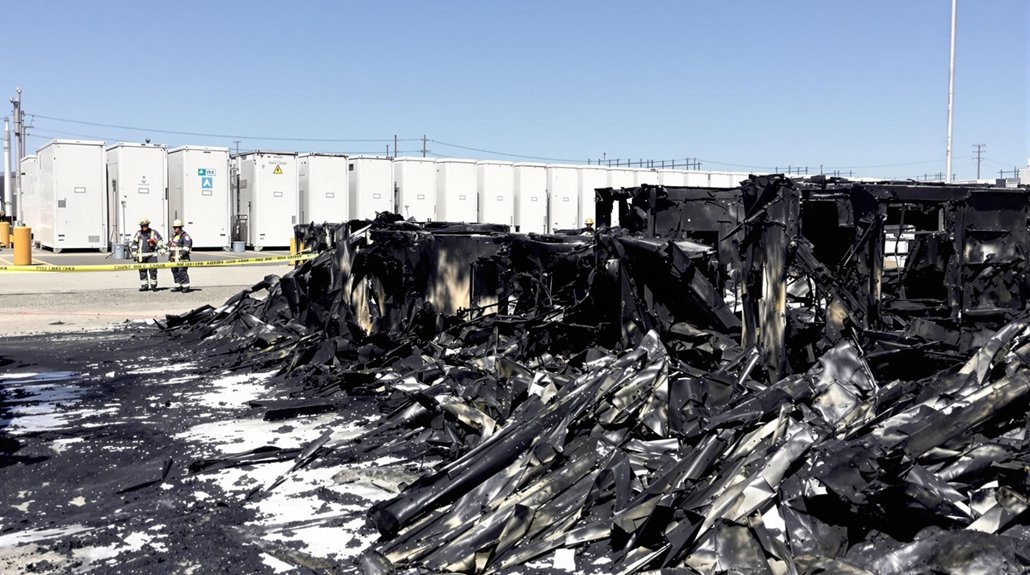
As battery companies watch their profits vanish into thin air, the industry finds itself in free-fall. Revenue in key markets like Texas has crashed, with California’s net annual revenues per kW plummeting from a respectable $103/kW in 2022 to a measly $53/kW in 2024.
Do the math: projects now face $55/kW revenue against $130/kWh costs. Last year? $192/kW revenue with $100/kWh costs. Not rocket science to see why 79 gigawatts of planned capacity got axed nationwide in 2025.
The numbers don’t lie: revenue crashed while costs skyrocketed, forcing companies to cancel projects left and right.
Battery costs have gone haywire, jumping to $130/kWh from $100/kWh. Thanks, tariffs! Chinese battery imports now face a whopping 145% tariff – though it’s temporarily down to 30% for a 90-day breather. Real helpful when 90% of U.S. lithium-ion batteries come from China.
The domestic supply chain isn’t exactly thriving either, getting hammered by tariffs on raw materials and equipment. The cancellations are brutal. Billions in planned manufacturing investments? Gone. Freyr Battery and Kore Power ditched their U.S. factory plans entirely.
Forecasts for grid battery additions this year got slashed from 18 GW to 13 GW. Next year looks even worse. Meanwhile, we’re drowning in global overcapacity. These challenges come as global energy storage shipments increased by 84.7% in 2025, creating a stark disconnect between capacity and profitability. Installed battery production exceeds demand, thanks to stalling EV sales.
China’s overproducing like crazy while Europe and North America can’t even meet local demand. Ironic, right? Supply chain nightmares continue with global shortages of skilled labor for high-voltage transformers and persistent long lead times for power equipment.
Nearly everything – raw materials, manufacturing equipment – comes from China. Good luck building that local supply chain overnight. Despite everything, analysts keep predicting rainbows and unicorns.
U.S. battery manufacturers have pledged to invest 100 billion dollars by 2030 to create a self-sufficient grid battery industry despite current market turmoil. The widespread adoption of renewable energy technologies remains hindered by storage limitations and the high costs of current battery solutions. U.S. EV battery capacity supposedly growing 90% to 421.5 GWh/year if ten plants open in 2025. The global battery market projected to hit $472.59 billion by 2032. Demand growing 33% annually to 4.7 TWh by 2030. Someone should probably tell them about the crisis happening right now.
References
- https://pv-magazine-usa.com/2025/12/19/u-s-battery-market-faces-a-make-or-break-year-in-2026/
- https://www.canarymedia.com/articles/energy-storage/tariffs-tax-credits-grid-battery-trump
- https://www.rolandberger.com/en/Insights/Publications/Battery-Monitor-2024-2025-A-turbulent-year-and-outlook-for-value-chain-players.html
- https://insideclimatenews.org/news/20022025/inside-clean-energy-ev-battery-manufacturing-capacity/
- https://www.mckinsey.com/industries/automotive-and-assembly/our-insights/battery-2030-resilient-sustainable-and-circular
- https://www.oxfordenergy.org/wpcms/wp-content/uploads/2025/04/OEF-144.pdf
- https://www.inkwoodresearch.com/reports/battery-market/
- https://elements.visualcapitalist.com/next-gen-battery-capacity-by-country-in-2025/