The battery revolution is happening right now—just not where most people are looking.
While the world obsesses over lithium, Chinese companies like CATL and BYD are quietly dominating the sodium-ion battery landscape. They’re not just talking—they’re building factories. By 2030, China will control over 90% of global sodium-ion capacity. That’s not a typo.
China isn’t just winning the sodium-ion battery race—they’re lapping everyone else while the West fixates on lithium.
Solid-state batteries are the tech everyone claims to be developing but few can actually produce. With energy densities up to 800 Wh/kg and non-flammable electrolytes, they make today’s batteries look like outdated flip phones.
Huawei’s version supposedly offers 2000 km range. Yeah, right—except maybe it’s true.
For AI data centers, flow batteries are stealing the spotlight. Non-flammable and capable of 6000+ cycles, they’re perfect for applications where space isn’t an issue but reliability is.
They’re like the reliable workhorse nobody appreciates until everything else fails.
Lithium-sulfur technology sounds like science fiction with its theoretical 2600 Wh/kg energy density. Perfect for maritime operations—if engineers can solve the pesky “shuttling effect” problem. Good luck with that.
Silicon anodes are the practical compromise. With nearly ten times the capacity of graphite anodes and using abundant materials, they’re the bridge technology we need.
Manufacturing complexity? Sure, but that’s solvable.
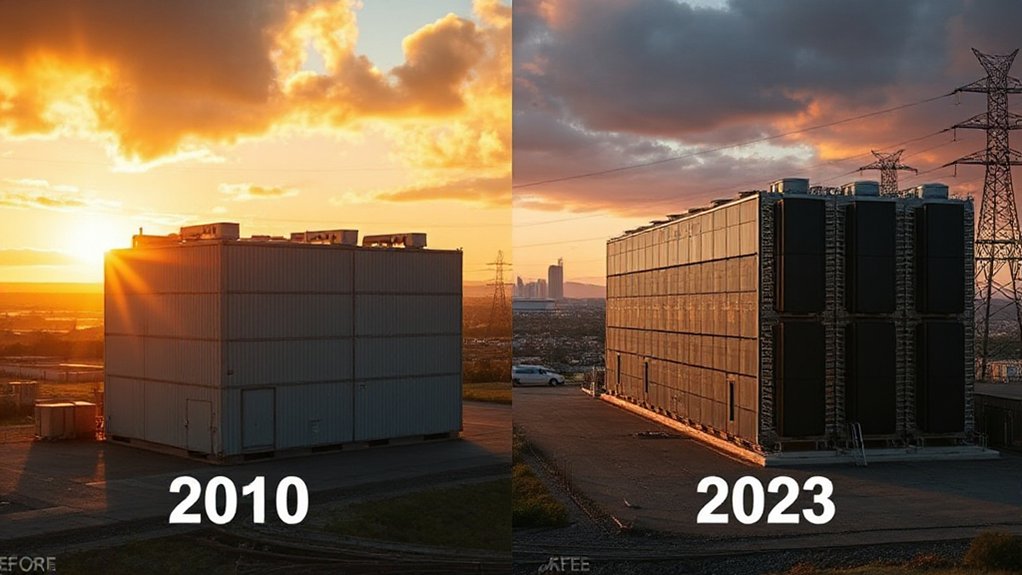
Zinc-based systems are making a comeback for stationary storage. Safe, affordable, scalable. They won’t power your Tesla, but they might keep your lights on during the next grid failure. The dramatic price drop of battery technologies since 2010 is making these alternatives increasingly competitive with traditional storage methods.
The dark horses? Chloride-ion batteries achieving 457.4 mAh/g, seawater batteries using biomass catalysts, and metal-air systems backed by DOE funding. Recent advances show remarkable performance improvements in sodium-sulfur batteries through adsorption-catalysis synergy.
Not sexy enough for headlines, but potentially game-changing.
The future won’t be dominated by a single technology. It’ll be a messy mix of solutions tailored to specific applications.
Lithium had its moment. The next wave is already forming—just follow the money to see where it’s heading.
Safety regulations coming post-2027 will likely accelerate adoption of these non-flammable chemistries, especially in regions prone to wildfires and dense urban areas.
References
- https://pubs.rsc.org/en/journals/articlecollectionlanding?sercode=se&themeid=6d062eb8-9e88-4947-b77f-a67002ac63f3
- https://www.pv-magazine.com/2026/01/02/battery-technology-outlook-for-2026-sharpens-beyond-lithium-ion/
- https://www.youtube.com/watch?v=_2klfPrAcLQ
- https://maritime-executive.com/editorials/energy-transition-strategies-advancing-emerging-battery-technologies
- https://www.powderbulksolids.com/industry-trends/q-a-battery-technology-industry-predictions-for-2026
- https://www.azom.com/article.aspx?ArticleID=24429
- https://gofourth.com/2026/01/02/2026-01-02-battery-technology-outlook-for-2026-sharpens-beyond-lithium-ion/