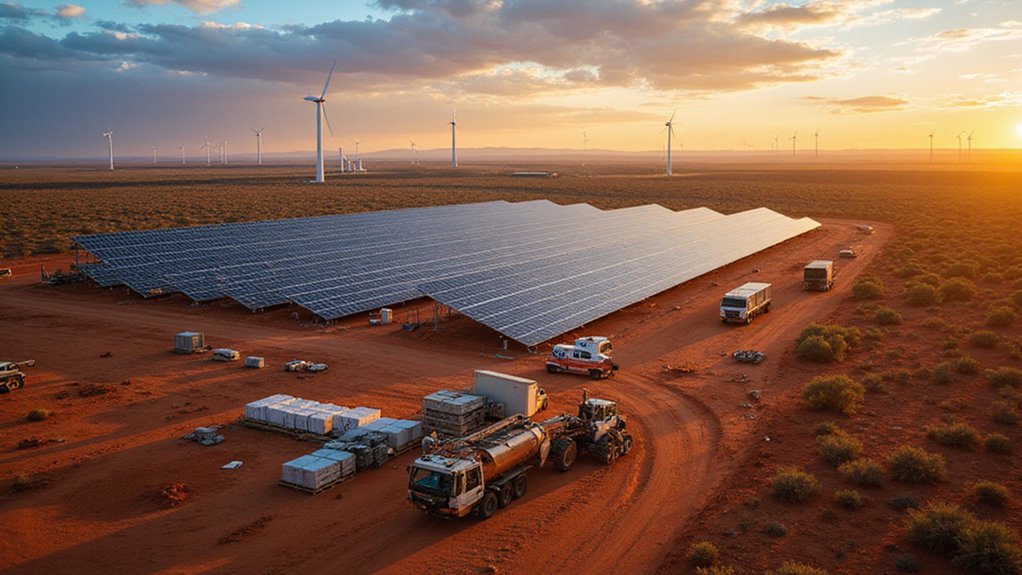
How can farmland damaged by salt pollution and poor drainage transform into a clean energy source? California’s Westlands Solar Park, located south of Fresno in Kings County, proves it can. The massive project converts unusable agricultural land into solar power plants that’ll eventually generate more electricity than any single power plant in the state.
The Westlands Water District owns the brownfield land where salt buildup and drainage problems made farming impossible. Instead of letting it sit unused, developers decided to build solar arrays there. This approach solves two problems at once: it creates clean energy and removes pressure on California’s best farmland elsewhere.
When complete, the project will have roughly 2.7 gigawatts of solar capacity. The real estate investment firm CIM Group joined the project in 2014 to help scale this ambitious vision. Approximately 50 project companies within a broader renewable energy initiative will reportedly be auctioned to renewable energy developers to accelerate deployment.
Construction’s already underway. The first demonstration project, a small 2-megawatt facility, started operating in 2016. The Aquamarine plant opened in 2021 with 125 megawatts of capacity. Other plants like Westlands Solar Blue and Chestnut Westside came online in 2023, each producing 150 to 250 megawatts. Additional projects named Westlands Grape and Cherry should be ready by December 2024.
The project covers roughly 21,000 acres of water-constrained land. That’s a lot of space, but it’s designed thoughtfully. Some areas use agrivoltaics, which combines solar panels with sheep grazing underneath. According to project plans, approximately 90 percent of the site is required to stay vegetated. This helps prevent dust and keeps the land productive even while generating power.
Environmental benefits extend beyond clean energy production. The solar farms reduce pressure on California’s groundwater and decrease salt pollution. They also improve air quality in the region. Plus, the project reportedly saves ratepayers approximately $9 billion by 2050. Projects like Westlands reflect a broader global shift toward renewable energy sources.
A transmission system connects this clean energy to California’s electrical grid. It’s a massive undertaking that transforms damaged farmland into one of the nation’s largest solar installations. The Westlands Solar Park demonstrates how California’s addressing its energy needs sustainably.
References
- https://wwd.ca.gov/wp-content/uploads/2017/12/westlands-solar-park.pdf
- https://en.wikipedia.org/wiki/Westlands_Solar_Park
- https://now.solar/2026/03/03/the-path-is-clear-for-the-largest-solar-farm-in-u-s-history-projects-weekly-solar-builder/
- https://www.altenergymag.com/news/2020/03/03/westlands-solar-park-one-of-the-largest-permitted-solar-parks-in-the-world-and-the-largest-in-north-america-starts-construction/32788/