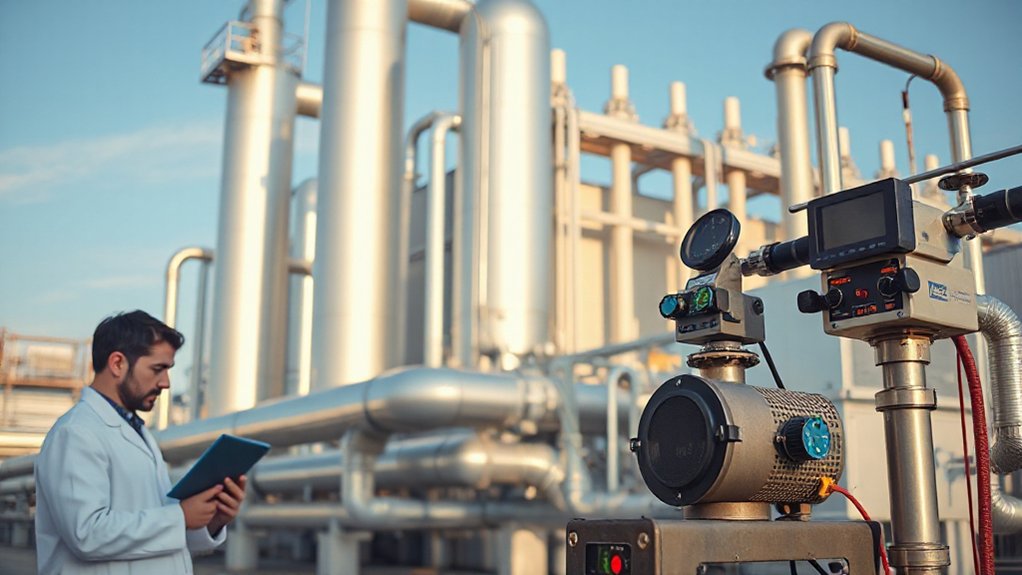
Dozens of carbon capture technologies are fighting for dominance in a rapidly evolving market. CarbonCloud freezes CO₂ into dry ice. SLB Capturi uses amines to grab 90% of emissions. PolarCap membranes do the same job with less energy. And Skyrenu pulls carbon straight from the air. They’re all jockeying for position in an increasingly crowded field. Good luck keeping track of them all.
The carbon capture race is heating up, with technologies freezing, grabbing, and pulling CO₂ from thin air.
Europe’s taking this seriously. Heidelberg Materials is slapping capture technology onto their Brevik cement plant next year. Germany’s testing Linde’s HISORP system that captures—get this—over 99% of emissions. Italy’s CapturEste project is snagging up to 70,000 tons of CO₂ yearly from burning trash. The EU has adopted the Net-Zero Industry Act targeting 50 Mt CO₂ per year of injection capacity by 2030. Progress? Sure. Enough? Not even close.
The numbers tell a sobering story. Carbon capture might handle 6% of global emissions by 2050. That’s after quadrupling capacity by 2030. Right now? It’s capturing a measly 0.5%. Hard to celebrate when the math is that depressing. Addressing carbon capture’s limitations is critical since fossil fuels still account for 75% of emissions globally.
These technologies aren’t created equal. Some cool gas until CO₂ freezes out. Others use enzymes to convert carbon dioxide to bicarbonate. Membrane systems operate at low pressure for dirty industries like steel and cement. The Filtree system stands out by removing approximately 40% of CO₂ from vessel exhaust using a removable on-board battery. They mostly work—when properly matched to their applications.
Regional preferences are emerging too. Europe focuses on steel and cement. China’s targeting coal power. The US is throwing tax credits at anybody willing to try. The North Sea’s getting crowded with projects, so the Adriatic is the new hot spot for CO₂ storage.
Here’s the brutal truth: capturing carbon is just step one. You’ve got to move it, store it, and—crucially—count it accurately. Without trustworthy emissions accounting, we’re just guessing at progress.
And in a market potentially worth billions, “close enough” isn’t going to cut it. The technology’s improving. The economics might even work. But without proper accounting? It’s just expensive greenwashing with extra steps.
References
- https://www.prescouter.com/report/top-10-carbon-capture-technologies-2025/
- https://www.catf.us/2025/11/carbon-capture-storage-europe-slow-but-significant-progress-2025/
- https://www.weforum.org/stories/2025/08/carbon-capture-storage-decarbonization-pivotal-moment/
- https://voices.uchicago.edu/triplehelix/2025/01/02/carbon-capture-is-there-a-future/
- https://newsroom.fluor.com/featured-stories/blog-details/2025/The-U-S–Carbon-Capture-and-Storage-Market-Fluors-Role-45Qs-Influence-Challenges-for-New-and-Existing-Technologies-and-Which-Projects-Can-Succeed/default.aspx
- https://www.globalccsinstitute.com/wp-content/uploads/2025/08/State-of-the-Art-CCS-Technologies-2025-Global-CCS-Institute.pdf
- https://carboncapturecoalition.org/wp-content/uploads/2025/09/CCC-2025-Federal-Policy-Blueprint.pdf