
While carbon markets once promised to be a savior in the climate crisis, they’re now experiencing a dramatic nosedive that has experts worried. EU emission allowance prices have plummeted 22% this year, hitting rock-bottom at €51 per tonne in February. Not exactly the growth story investors were banking on. And it’s not just Europe feeling the pain.
The numbers tell a grim tale. Carbon credit issuances dropped 10% in the first half of 2025 compared to last year. Meanwhile, a staggering 1.5 billion credits are floating around in the market. Talk about oversupply. It’s Economics 101 – too much product, not enough demand, prices crash. Simple as that.
Supply and demand 101: when you’re swimming in carbon credits, prices drown in their own abundance.
The voluntary market is drowning in its own mediocrity. Despite billions spent on offsets, atmospheric CO2 keeps breaking records. Funny how that works, isn’t it? Buy credits, feel good, planet still cooks. The whole system reeks of wishful thinking rather than actual climate action. Research shows that less than 10% of carbon offsets actually deliver genuine, measurable emission reductions. This contradicts projections that the market could reach 250 billion dollars by 2050, according to industry optimists.
Regulators are finally catching on. The Integrity Council launched new principles this year, and major registries like Verra updated their methodologies. The U.S. market shows some diversity with over 2,300 active projects currently operating in the voluntary carbon market. About time. When your market’s credibility is in the toilet, something’s gotta give.
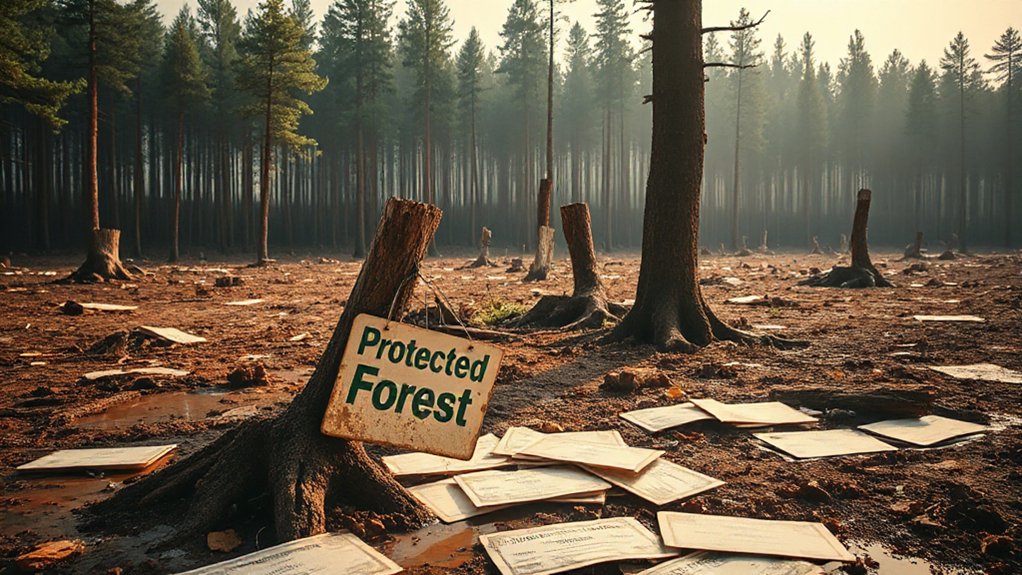
Forest protection projects are particularly vulnerable in this freefall. These were supposed to be the poster children of carbon markets – save trees, save the planet! Now they’re withering on the vine as funding dries up. Turns out investors aren’t keen on pouring money into projects with questionable returns.
The policy landscape isn’t helping either. While carbon pricing mechanisms cover 28% of global emissions, political winds shift fast. One election can undo years of market development.
For all the grand promises, carbon markets haven’t delivered the climate punch they advertised. The relationship between price and real carbon reduction remains tenuous at best. As one market analyst put it recently: great concept, terrible execution. That about sums it up.
References
- https://www.esma.europa.eu/sites/default/files/2025-10/ESMA50-481369926-30552_Carbon_Markets_Report_2025.pdf
- https://blog.alliedoffsets.com/key-trends-in-the-u.s.-voluntary-carbon-market-1
- https://carboncredits.com/study-finds-carbon-offsets-failing-to-deliver-real-climate-impact/
- https://climatefocus.com/wp-content/uploads/2025/07/First-Half-2025-VCM-Review-and-Outlook.pdf
- https://www.worldbank.org/en/publication/state-and-trends-of-carbon-pricing
- https://icapcarbonaction.com/en/publications/emissions-trading-worldwide-icap-status-report-2025
- https://www.erm.com/insights/the-return-of-the-carbon-credit/