China and Russia aren’t messing around with lunar ambitions. They’re building a nuclear reactor on the moon by 2035, with work starting in 2028. Meanwhile, America’s still debating budgets. The duo plans a permanently staffed base by 2030, targeting the resource-rich south pole. Their coalition aims to include 5,000 researchers from 50 countries. Talk about leaving NASA in the lunar dust. The geopolitical implications? Pretty massive.
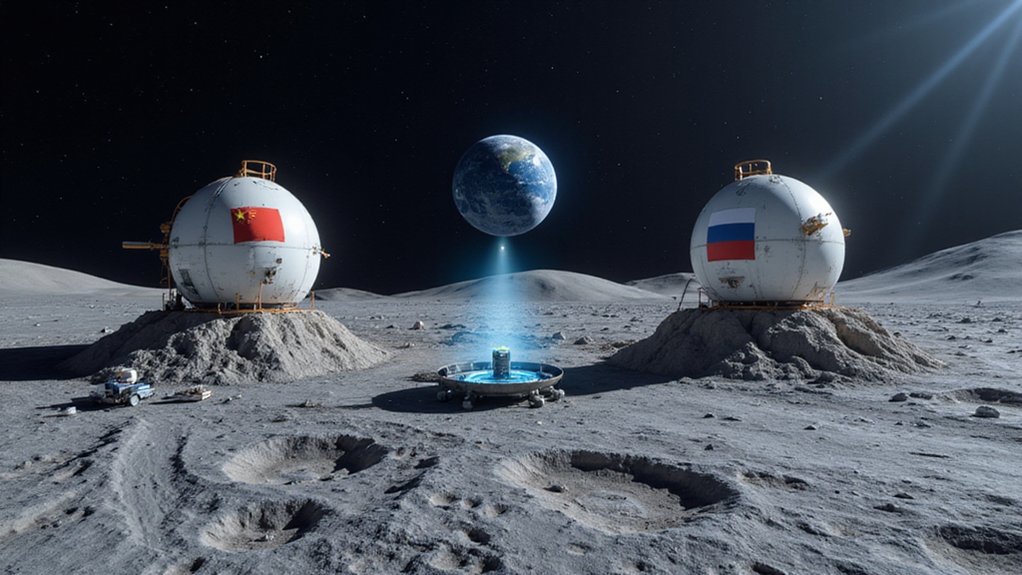
While the U.S. continues to debate budgets and timelines, China and Russia are pushing ahead with ambitious plans to establish nuclear dominance on the lunar surface. The two nations have formally committed to building a nuclear power plant on the Moon by 2033-2035, with preliminary work starting as early as 2028.
America? Still drawing up proposals.
China publicly endorsed this lunar nuclear initiative in April 2025, cementing their partnership with Russia for the International Lunar Research Station (ILRS) near the Moon’s south pole. It’s not just talk. They’ve got dates, plans, and robots ready to go.
The Chang’e-8 mission, scheduled for 2028-2029, will test construction techniques and energy systems essential for the lunar base. This timeline puts China and Russia years ahead of NASA’s similar efforts. By 2030, they aim to have a permanently staffed base. By 2035, a fully operational nuclear reactor.
Meanwhile, American astronauts might still be practicing lunar landings.
Russia isn’t just bringing nuclear know-how to the Moon. They’re developing a nuclear-powered space tugboat too. Because why stop at one nuclear project when you can have two?
This partnership isn’t merely scientific. It’s strategic gold. The initiative challenges U.S. space dominance and extends the global space race into new territory – nuclear-powered moon presence.
With plans to involve up to 50 countries and 5,000 researchers, China’s aiming for a coalition that dwarfs NASA’s Artemis program.
Nuclear power makes perfect sense for lunar operations. The Moon’s two-week nights render solar power problematic. A nuclear reactor guarantees consistent energy for life-support systems and equipment.
Russia’s expertise here is vital – they’ve actually put nuclear reactors in space before.
The message is clear. While America talks about returning to the Moon, China and Russia are planning to stay there – with permanent infrastructure, nuclear power, and a coalition of willing partners.
The next giant leap? It might not have American footprints.
The lunar south pole is an especially strategic location for the base, as it contains valuable resources including helium-3 deposits that could potentially meet Earth’s energy needs for thousands of years.
China has also been exploring large-scale solar arrays as an alternative energy source for their lunar operations, although the nuclear option appears to be gaining favor.
References
- https://www.sustainability-times.com/low-carbon-energy/us-in-total-shock-china-and-russias-2028-plan-to-build-a-nuclear-reactor-on-the-moon-stuns-the-global-space-community/
- https://www.the-independent.com/space/moon-china-nuclear-power-plant-base-russia-b2737945.html
- https://www.youtube.com/watch?v=0-d7ksVeTeM
- https://asiatimes.com/2025/04/us-china-in-hot-race-to-put-nuclear-reactors-on-the-moon/
- https://san.com/cc/china-formally-backs-nuclear-reactor-on-the-moon-with-russia/