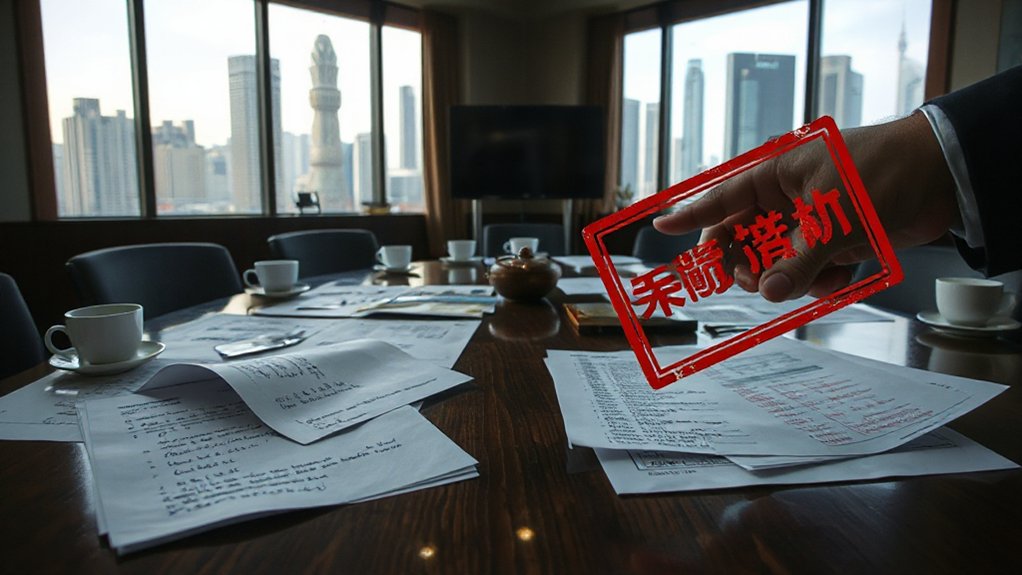
Nearly a dozen major polysilicon producers in China got a rude awakening when the State Administration for Market Regulation (SAMR) shut down their industry-led scheme to manipulate market prices.
The regulator halted a CNY 50 billion consolidation plan that reeked of collusion. Turns out “industrial self-discipline” is just fancy talk for price fixing. Who knew?
SAMR didn’t mince words. They labeled the whole operation as “monopoly agreements” after discovering the companies were coordinating output, sales volumes, and capacity reduction.
Pretty clever scheme, until it wasn’t. The timing couldn’t have been more obvious—polysilicon prices had somehow jumped 34.4% year-on-year by November 2025 despite weak downstream demand. Nothing suspicious there!
The China Photovoltaic Industry Association (CPIA) played matchmaker, hosting monthly coordination meetings where producers could chat about production cuts, maintenance schedules, and price floors.
Cozy little gatherings. Meanwhile, the China Nonferrous Metals Industry Association (CNMIA) helpfully tracked and publicized price movements. Both associations preached against “vicious price competition.”
Translation: don’t you dare lower prices.
The market impact was real. N-type re-charge polysilicon averaged CNY 59,200 per metric ton, up nearly 10% week-on-week.
N-type granular silicon? CNY 55,800, up 10.5%. New orders cleared CNY 60,000. Not bad for a “struggling” industry.
SAMR’s intervention was swift. The regulator banned agreements on production volumes, capacity levels, pricing, output quotas, profit sharing, and market division.
They even prohibited detailed information exchanges that could facilitate collusion. These producers had significant leverage over the supply chain, directly impacting wafer price increases ranging from 8.40% to 9.21%.
The message was crystal clear: cut it out or face formal investigations.
The CPIA quickly suspended their monthly meetings and stopped all coordinated measures. The six major players involved – Tongwei, GCL, Daqo, Xinte, East Hope, and Asia Silicon – control 2.5 million MT capacity of polysilicon production.
Funny how fast “industry self-discipline” evaporates when antitrust regulators start asking questions.
The polysilicon giants learned a valuable lesson: secret pricing schemes aren’t so secret when prices magically rise during a demand slump.
References
- https://www.pv-magazine.com/2026/01/09/chinas-competition-regulator-halts-7-billion-polysilicon-consolidation-plan/
- https://www.pv-magazine.com/2026/01/09/polysilicon-prices-jump-over-9-as-china-supply-tightens/
- https://www.pv-tech.org/chinese-polysilicon-production-has-recorded-its-first-decline-in-12-years-cpia/
- https://www.youtube.com/watch?v=fHV4DMJGyqc
- https://www.mlex.com/mlex/antitrust/articles/2428273/china-photovoltaic-sector-s-price-discipline-sparks-antitrust-allegations