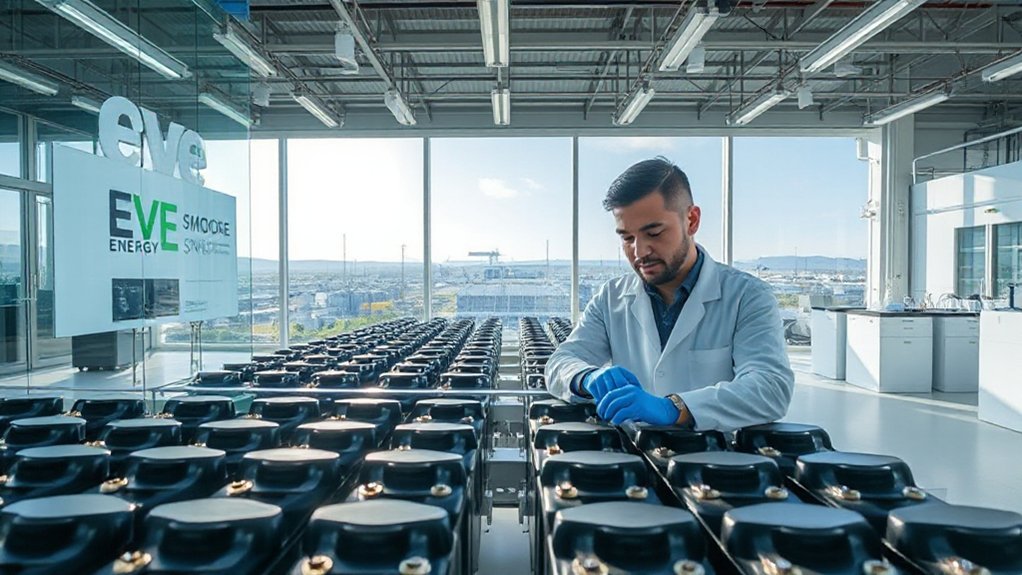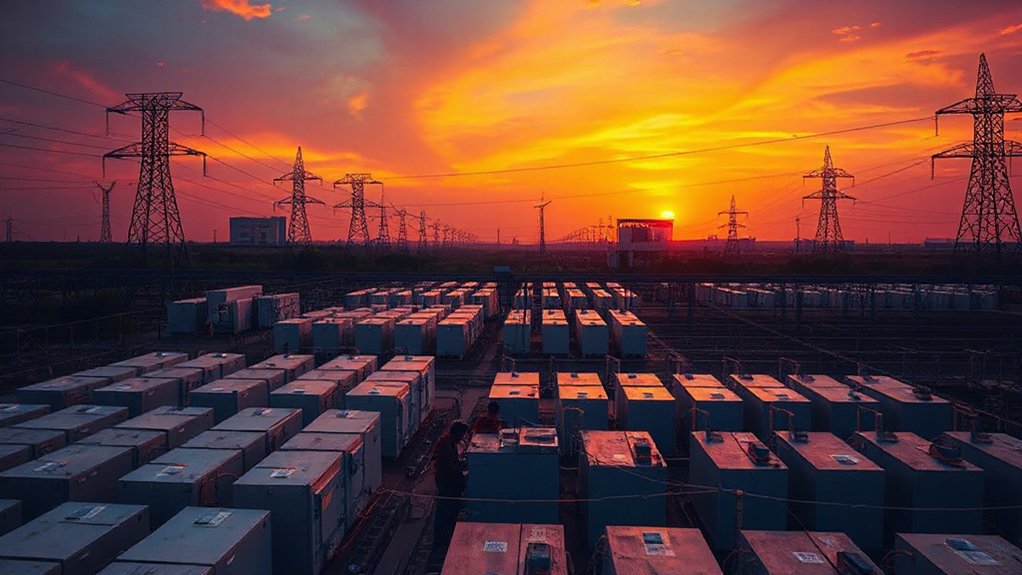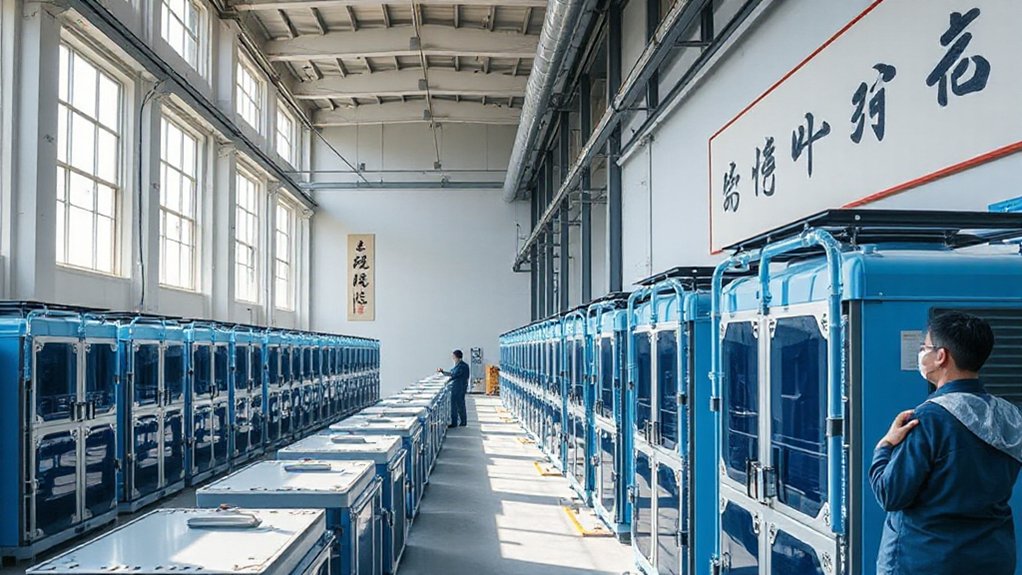

While Western battery manufacturers struggle to keep pace, Chinese companies have quietly revolutionized energy storage efficiency. The numbers don’t lie. Chinese LFP battery systems routinely hit round-trip efficiencies of 92-96%, leaving Western NMC/NCA storage systems in the dust at a measly 88-92%. Do the math. That’s 3-8 percentage points more usable energy per cycle. Not small potatoes when you’re talking grid-scale deployments.
China’s LFP revolution isn’t just marginal—it’s redefining energy storage with efficiencies Western manufacturers can only dream about.
It’s not just about chemistry. It’s engineering brilliance. Chinese manufacturers have mastered the art of cell structure. Their Wending-type optimized internal structures improve current pathways and slash internal resistance. Less heat. More power. The result? Next-gen Chinese LFP cells exceed 96% efficiency at 0.25P. Western companies are still scratching their heads, wondering how they got left behind so quickly.
The gap widens when you look at longevity. These aren’t your disposable Western batteries. Chinese LFP storage cells deliver 10,000-14,000+ full cycles with enough capacity retention to last over 20 years. They’ll be powering homes when today’s smartphones are museum pieces.
Size matters too. Larger format prismatic cells (392Ah, 587Ah) reach about 190 Wh/kg at cell level. Fewer connectors, fewer welds, fewer components to leak energy. And China isn’t stopping there. Their advanced lithium-metal and semi-solid projects are targeting a mind-blowing 400-600 Wh/kg cell density.
The efficiency advantage isn’t just technical—it’s philosophical. Chinese manufacturers have shifted from “scale expansion” to quality improvement. Higher production yields. Lower parasitic losses. Meanwhile, Western companies cling to outdated chemistries and production methods.
The future? Chinese hybrid-vehicle batteries expect 50% increased cycle life with costs falling to 0.6 yuan/Wh. That expertise transfers directly to stationary storage. No cobalt, no nickel, just stable LFP chemistry with higher thermal stability. Less cooling needed. More efficiency gained. Game over.
This dominance extends to the utility-scale sector where Chinese manufacturers will install over 1.5 GW of new capacity, revolutionizing grid stability and renewable energy storage.
By 2026, the market concentration will intensify with the top 5 enterprises projected to exceed 85% market share, further solidifying China’s dominant position in the global battery industry.
References
- https://www.yesabattery.com/news/analysis-of-china-s-lithium-battery-industry-development-in-2026-and-its-impact-on-the-automotive-battery-industry/
- https://www.reptbattero.com/blog/more-brands-choosing-lfp-battery-cells-2026/
- https://battery-tech.net/battery-markets-news/chinas-lithium-battery-demand-to-fall-sharply-in-early-2026/
- https://about.bnef.com/insights/clean-energy/china-regains-number-one-spot-in-bloombergnefs-global-lithium-ion-battery-supply-chain-ranking/
- https://cnevpost.com/2025/12/29/china-battery-demand-to-tumble-early-2026-cpca-head/
- https://www.batterytechonline.com/design-manufacturing/chinas-battery-dominance-innovation-price-wars-reshape-global-market
- https://netzerocompare.com/articles/chinas-lithium-battery-demand-set-to-slow-in-early-2026-industry-warns
- https://discoveryalert.com.au/china-lithium-price-surge-market-shift-2026/
- https://mexicobusiness.news/automotive/news/china-lithium-battery-demand-seen-falling-early-2026