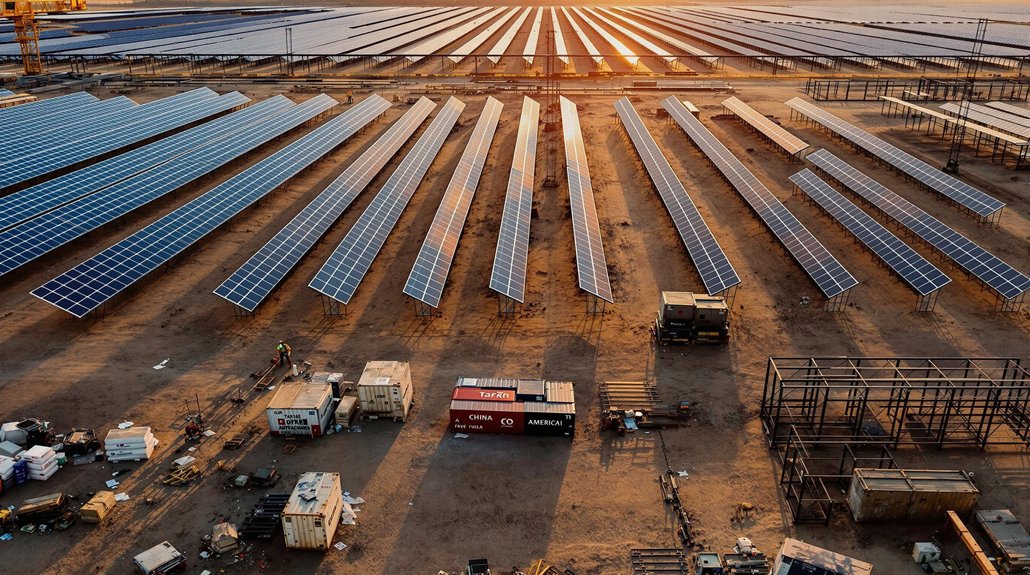
Clean energy investment hit a remarkable $2.2 trillion globally in 2025, marking an 8% jump from the previous year’s $2.1 trillion. This surge reflects growing commitment to renewable energy and sustainable technologies worldwide. BloombergNEF reports the total at $2.3 trillion when including all clean energy categories. Overall energy investment reached $3.3 trillion, up just 2% from 2024.
Clean energy investment surged to $2.2 trillion globally in 2025, an 8% increase reflecting growing worldwide commitment to renewable and sustainable technologies.
The investment breakdown shows electric transport leading the way with $893 billion spent on electric vehicles and charging infrastructure. Renewable energy captured $780 billion, primarily directed toward solar and wind projects. Energy efficiency improvements and end-use investments totaled $773 billion. Power grids received an estimated $483 billion for transmission and distribution upgrades. Emerging sectors like hydrogen and nuclear received roughly $7.3 billion and $36 billion respectively. However, grid infrastructure is currently failing to keep pace with power demand growth and renewable penetration, necessitating a doubling of grid investment to meet commitments for tripling renewable capacity by 2030.
A significant milestone occurred this year as clean energy investment doubled fossil fuel investment at $1.1 trillion. This represents the second consecutive year clean energy surpassed fossil fuels. The electricity sector received $1.5 trillion in investment, roughly 50% more than fossil fuel spending. Fossil fuel supply investment actually dropped $9 billion compared to the previous year. Climate-tech equity funding demonstrated strong recovery momentum with a 53% rebound to $77.3 billion in 2025.
Regional growth varied across the globe. The European Union led with 18% growth, reaching $455 billion in clean energy investment. The United States increased investments by 3.5% to $378 billion. India showed impressive momentum with a 15% increase to $68 billion, driven primarily by renewable and grid projects. Net fossil importers like China, Europe, and India boosted investments by 70%, spurred by recovery packages and energy independence goals. In the United States alone, the Inflation Reduction Act is reportedly projected to pump $114 billion into renewable energy investments by 2031, accelerating the country’s shift away from fossil fuels.
Despite these gains, fossil fuels still generate approximately 60% of global electricity. This gap highlights the ongoing challenge in moving away from traditional energy sources. Clean technologies now comprise two-thirds of total energy investment, demonstrating a fundamental shift in how the world funds its power systems. Experts project this trend will continue for a third consecutive year as grid upgrades and electrification efforts expand. The momentum suggests clean energy’s growing dominance will reshape global energy infrastructure in coming years.
References
- https://www.pv-tech.org/iea-clean-energy-investment-to-hit-us2-2-trillion-in-2025/
- https://carboncredits.com/clean-energy-investment-hits-record-2-3t-in-2025-evs-and-renewables-lead-the-surge/
- https://sustainabilitymag.com/articles/iea-report-2025-clean-energy-investment-to-reach-us-2-2tn
- https://about.bnef.com/insights/clean-energy/bloombergnef-finds-global-energy-transition-investment-reached-record-2-3-trillion-in-2025-up-8-from-2024/
- https://www.wri.org/insights/state-clean-energy-charted