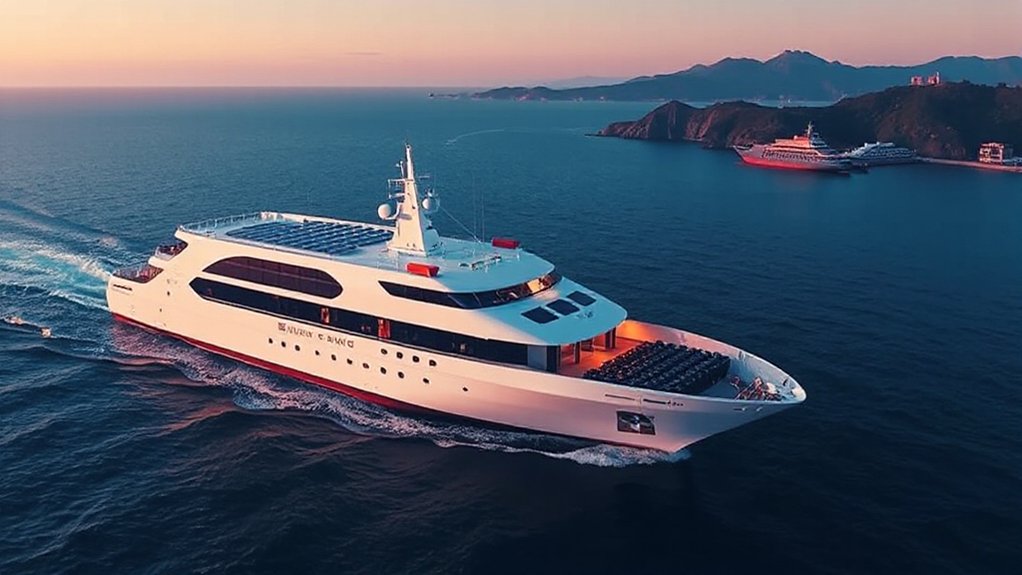

As the maritime industry grapples with its carbon footprint, zero-emission ferry batteries are making waves—big ones. A revolutionary ferry service has just launched with a jaw-dropping 40 MWh battery system. Not your average electric boat. This beast dwarfs typical electric ferries, which usually pack between 0.4 and 4.6 MWh. We’re talking serious power here.
The massive battery installation weighs over 250 tonnes. Yeah, that’s not a typo. Engineers had to completely rethink structural design and stability requirements to accommodate what amounts to a floating power plant. It’s like strapping a small grid to a boat and hoping it floats. Spoiler alert: it does.
250 tonnes of maritime innovation—like bolting a power plant to a boat and crossing your fingers. It actually works.
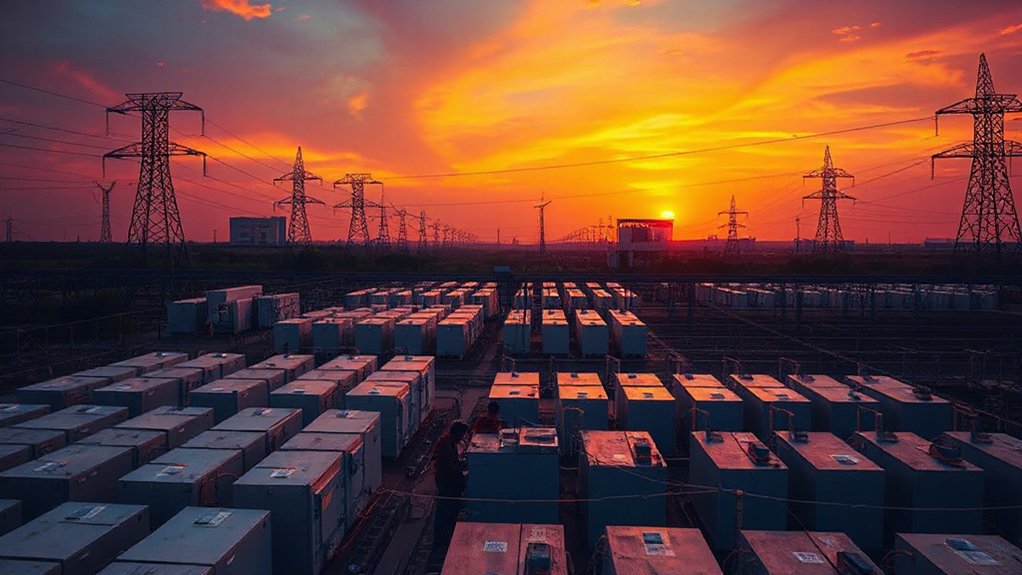
Charging this monster isn’t like plugging in your Tesla. The ferry requires ultra-high-capacity DC fast chargers delivering multiple megawatts per berth. Local power grids weren’t ready for this kind of demand, obviously. Extensive upgrades were necessary, including dedicated substations and harbor-side buffer batteries that charge during off-peak hours. This approach resembles the solution implemented for the Kinsarvik ferry in Norway, which uses buffer battery packs to overcome local grid limitations.
The battery system uses specialized lithium-ion chemistry selected for maritime conditions. The entire architecture includes robust thermal management systems and fire suppression—because nobody wants a battery fire at sea. Trust me. This ferry represents a microcosm of the grid transformation happening globally as battery storage enables higher renewable energy integration.
Designers implemented a modular approach with redundant systems. Smart move. This allows for maintenance without completely halting service. The onboard energy management system constantly optimizes power allocation between propulsion and auxiliary systems. This approach aligns with the Current Direct project’s goal of developing swappable battery solutions for waterborne transport.
The ferry employs a partial charging strategy, topping up during turnarounds instead of fully charging each time. Operating at approximately 75% depth-of-discharge with 90% round-trip efficiency, the system maximizes both operational time and battery lifespan.
Perhaps most innovative is the commercial model behind the project. Energy-as-a-service agreements reduce upfront costs for operators, making the economics work despite the massive infrastructure investments. Electric maritime transport isn’t just cleaner—it’s becoming financially viable.
This South American crossing represents the future. Big batteries. Zero emissions. Game changer.
References
- https://cordis.europa.eu/article/id/436334-another-milestone-in-battery-powered-zero-emission-transport-for-ships
- https://www.zf.com/mobile/en/technologies/electric_mobility/stories/e_ferries_reducing_the_ecological_footprint_.html
- https://eepower.com/news/worlds-largest-electric-ferry-carries-275-tons-of-batteries/
- https://www.allamericanmarine.com/sanfranciscobayferry-reef-contract/
- https://www.leclanche.com/wp-content/uploads/2022/05/Zero-Emission-Ferry-and-Onshore-Battery-Energy-Storage-System.pdf
- https://theicct.org/wp-content/uploads/2021/06/chinese-coastal-ferries-electric-apr2021.pdf
- https://www.wartsila.com/marine/products/ship-electrification-solutions/28-05-2025-wartsila-to-supply-the-electric-propulsion-system-for-usa-s-first-battery-electric-zero-emission-high-speed-passenger-ferries-3590753
- https://candela.com/blog/electric-ferries-range-sustainability-explained/