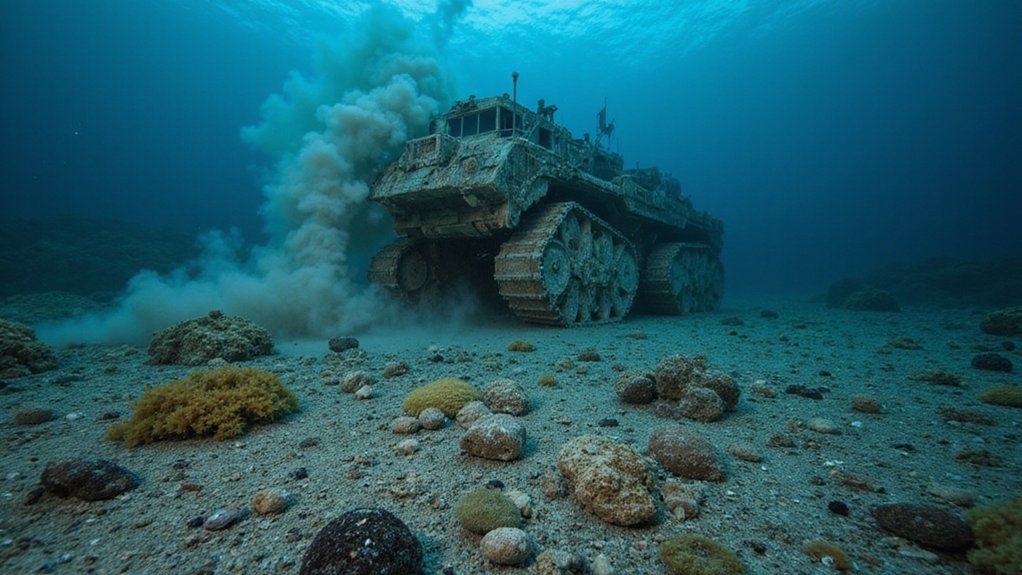
Destruction on an epic scale. That’s what scientists are finding when they examine the aftermath of deep-sea mining operations on the ocean floor. Mining vehicles crush sponges and filter feeders like you’d step on ants. They rip out polymetallic nodules—tiny underwater homes that took millions of years to form—leaving nothing but barren seafloor. A single operation can wreck up to 700 km of nodules. Gone. Just like that.
The damage doesn’t stop at the extraction site. Sediment plumes billow out like underwater dust storms, traveling kilometers beyond mining zones. These clouds smother and suffocate creatures that can’t escape fast enough. Imagine trying to breathe while someone dumps sand down your throat. That’s daily life for these organisms when mining starts.
Recovery? Don’t hold your breath. Scientists examining seafloor sites 44 years after disturbance found tracks looking practically new, as if they were made yesterday. The deep sea operates on a different timeline than we do. What takes us decades to destroy might take nature millennia to rebuild—if ever.
The casualties are unique species found nowhere else on Earth. Many are rare, slow-growing, and completely dependent on nodules as anchor points. Remove the nodules, and you’ve fundamentally condemned entire communities to extinction. No dramatic headlines, just silent disappearance.
And let’s not forget the sensory assault. Mining equipment creates a hellscape of noise, light, and heat in an environment adapted to darkness and silence. In the Clarion-Clipperton Zone alone, scientists have discovered over 5,000 new species that could be wiped out before we even understand their ecological importance. For deep-sea creatures, it’s like having a construction site in your bedroom. Forever.
The potential ripple effects are terrifying. Disruption of these delicate ecosystems could impact fisheries that millions of people rely on for food. The seabed’s role in carbon sequestration could also be severely compromised, potentially worsening climate change effects. But hey, we need those minerals for our phones, right?
Science is sending a clear message: these seafloor wounds don’t heal. Not in our lifetime, maybe not ever. Once we break it, we can’t fix it.
References
- https://www.frontiersin.org/journals/marine-science/articles/10.3389/fmars.2025.1598584/full
- https://www.wri.org/insights/deep-sea-mining-explained
- https://noc.ac.uk/news/new-study-reveals-long-term-impacts-deep-sea-mining-first-signs-biological-recovery
- https://www.bgs.ac.uk/news/new-study-reveals-long-term-effects-of-deep-sea-mining-and-first-signs-of-biological-recovery/
- https://www.iucn.nl/en/story/the-impact-of-deep-sea-mining-on-biodiversity-climate-and-human-cultures/