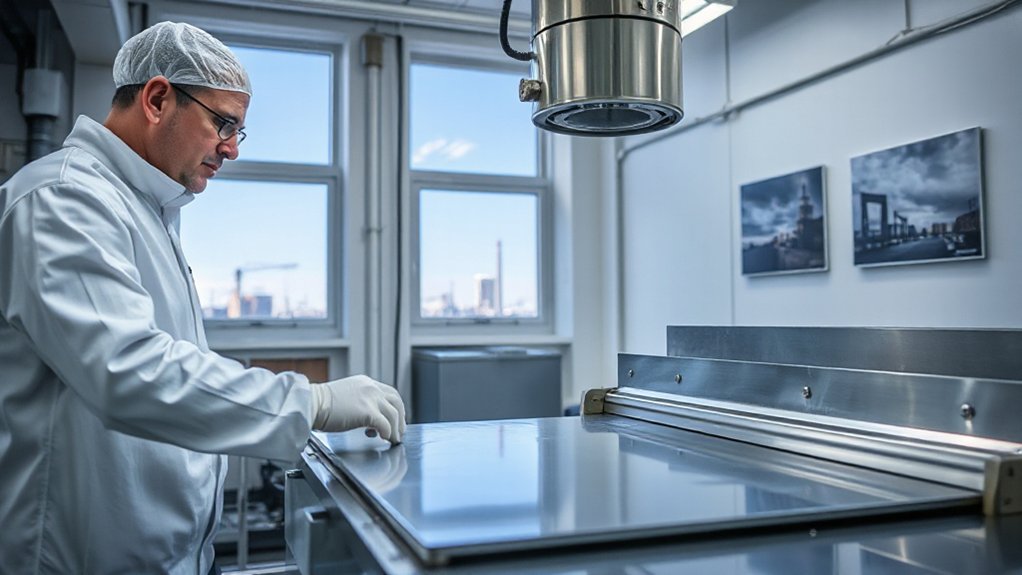

While traditional battery manufacturing has relied on wet, messy solvents for decades, a revolution is quietly transforming the industry. Dry battery coating is here, and it’s about to make those toxic solvents obsolete. No more NMP. No more massive drying ovens. Just powder, pressure, and a whole lot of common sense.
The process is surprisingly straightforward. Take your active materials, mix them with conductive additives and dry binders like PTFE (yes, the same stuff in your non-stick pans), then apply directly to current collectors using pressure, heat, or electrostatic methods. No liquid, no mess, no waiting around for solvents to evaporate. It’s like going from a sloppy watercolor to a precise digital print.
Dry coating isn’t rocket science—it’s elegant simplicity that makes wet processes look wasteful and outdated.
The environmental impact? Massive. We’re looking at CO₂ emissions slashed by up to 25% in battery production. That’s 7 million tonnes of carbon dioxide that simply won’t exist. Who knew eliminating fancy drying ovens could do so much for the planet? And let’s not pretend we’ll miss handling carcinogenic NMP – Europe’s already showing it the door with tightening regulations.
Financially, it’s a no-brainer. Factory footprints shrink by up to 60%. Less equipment, less energy, less maintenance, less headache. Battery makers are practically salivating at the capital savings.
The batteries themselves? They’re actually better. More uniform coatings, higher density, and potentially longer lifespans without those pesky solvent residues causing trouble. Thicker electrodes without cracking means higher capacity cells that don’t overheat. This technology complements the growing battery storage capacity that nearly doubled in 2024, reaching 29 GW nationwide.
Of course, there are challenges. Getting dry films to stick properly to current collectors isn’t child’s play. Companies like Henkel are developing specialized conductive coatings to solve this, while Tesla races to scale the technology. Addionics’ innovative 3D porous current collectors create direct adhesive bonds with active materials, eliminating the need for priming altogether. The electrostatic spraying technique ensures uniform distribution of particles across the substrate, helping to overcome some of these adhesion challenges.
The future of battery manufacturing is dry, clean, and efficient. No solvents, no drying, no nonsense. Just better batteries with a smaller carbon footprint. Sometimes revolution comes not with a bang, but with the quiet elimination of unnecessary steps.
References
- https://www.infinitypv.com/roll-to-roll-academy/what-is-dry-battery-electrode-technology-and-how-does-it-work
- https://addionics.com/blog/the-future-of-batteries-starts-with-dry-coating/
- https://www.ffb.fraunhofer.de/en/press/ffb-blog/DryCoating.html
- https://chargedevs.com/features/a-closer-look-at-li-ion-dry-electrode-coating-technology/
- https://www.batterytechonline.com/trends/why-is-tesla-using-dry-battery-electrode-technology-
- https://volta.foundation/battery-bits/conductive-coatings-enabling-dry-battery-electrode-manufacturing
- https://www.youtube.com/watch?v=mQFFVxFOPh8
- https://pmc.ncbi.nlm.nih.gov/articles/PMC11123077/