
Four billion dollars. That’s how much the commercial heat pump market is projected to grow annually over the next decade. Not exactly small change. The global market, already worth around $17 billion, is expanding at a blistering 11-13% annual rate. By 2035, we’re looking at a $45-61 billion industry. Numbers don’t lie.
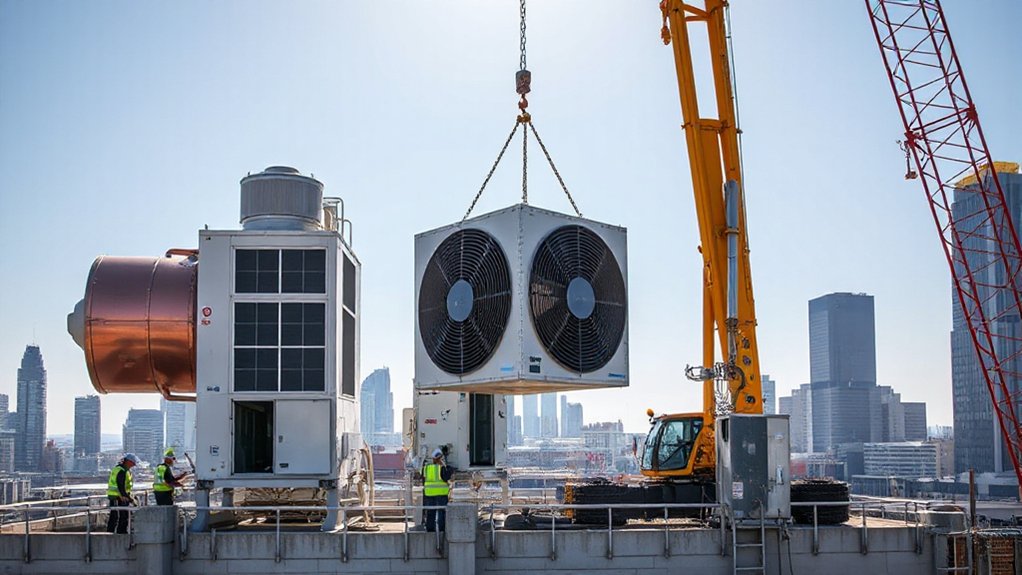
These aren’t your grandma’s heat pumps. The commercial sector is going big—really big. Those massive 15-ton units are revolutionizing how buildings stay warm. They’re not just replacing gas furnaces; they’re obliterating the need for them. In the first half of 2025, heat pumps outsold gas furnaces by 25% in the U.S. market. Pretty telling, right?
Commercial heat pumps aren’t just changing the game—they’re creating an entirely new playing field.
European adoption is equally impressive, with unit sales jumping 9% year-to-date. Nearly a million units sold in just six months. That’s not a trend—it’s a revolution. And it makes perfect sense. These systems transfer heat instead of generating it, slashing direct CO2 emissions when powered by clean electricity. With energy storage growth enabling higher renewable integration, heat pumps become an even more attractive solution for decarbonizing buildings.
Sure, the upfront costs can be steep. Installation complexities in retrofits don’t help. But the math eventually works out. Lower operational costs versus gas, especially as electricity gets cleaner, make the long-term economics compelling.
Add government incentives to the mix, and suddenly payback periods don’t look so intimidating. The U.S. heat pump market has already reached 11.2 billion dollars in 2024 and continues growing at an impressive rate. Large commercial buildings are particularly prime for conversion. The food and beverage, chemical, and pharmaceutical industries are jumping on board fast. Why wouldn’t they? These systems can deliver space heating, hot water, and process heat all at once.
The healthcare sector is leading adoption with 29.7% market share, demonstrating the critical importance of reliable heating and cooling in medical facilities. The refrigerant situation is evolving too. New manufacturing rules now require low-GWP refrigerants for residential and light commercial applications. A minor headache for manufacturers, but nothing they can’t handle.
Bottom line: those hulking 15-ton heat pumps aren’t just another option—they’re the future. Gas dependency in commercial buildings isn’t dying; it’s being systematically dismantled. One massive heat pump at a time.
References
- https://www.futuremarketinsights.com/reports/commercial-heat-pump-market
- https://leads4build.com/insights/hvac-statistics-trends
- https://ehpa.org/news-and-resources/market-data/heat-pump-sales-up-9-in-2025-so-far/
- https://www.researchnester.com/reports/commercial-heat-pump-market/6196
- https://www.prnewswire.com/news-releases/industrial-heat-pumps-market-to-grow-by-usd-754-8-million-2025-2029-driven-by-energy-efficiency-focus-with-ai-impacting-market-trends—technavio-302372983.html
- https://rmi.org/insight/tracking-the-heat-pump-water-heater-market-in-the-united-states/
- https://www.marketreportsworld.com/market-reports/heat-pump-market-14722186
- https://blog.bccresearch.com/top-5-trends-shaping-the-global-heat-pump-market