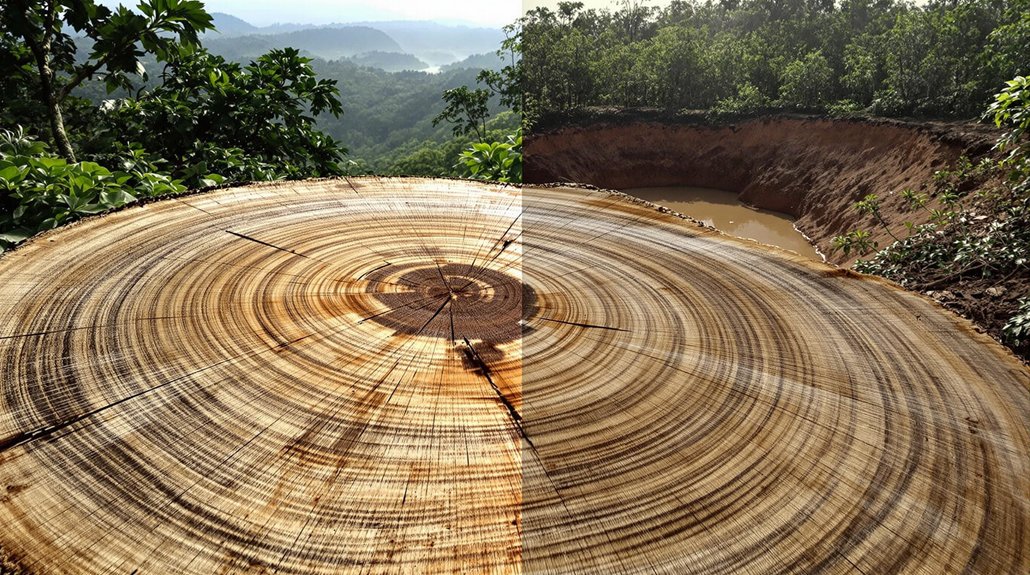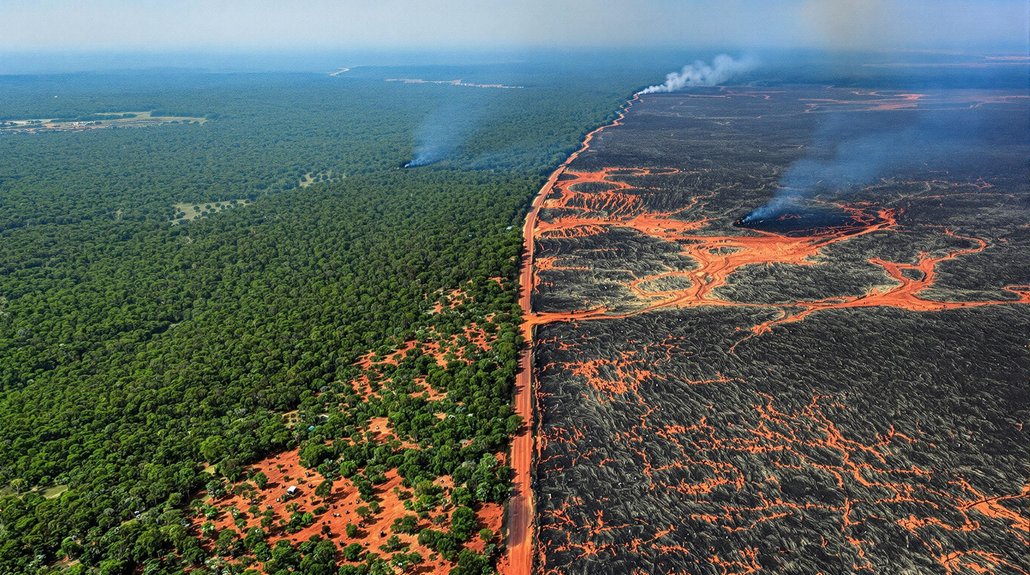
While world leaders prepare for climate talks at Brazil’s upcoming COP30, the Amazon rainforest is vanishing at an alarming rate. Over 54.2 million hectares have disappeared in just two decades—an area bigger than Spain. Gone. Vanished. And the pace isn’t slowing down.
Look at the numbers. They’re staggering. In five short years, nearly 23.7 million hectares were cleared, roughly the size of the United Kingdom. This May, Brazil’s portion alone lost 960 square kilometers, a jaw-dropping 92% increase from 2024. That’s what preparation for a climate conference looks like, apparently.
The culprits? No mystery there. Illegal fires. Cattle ranching. Agricultural expansion. The typical human playbook for converting ancient forests into quick cash. Criminals are increasingly using fire as a tactic for illegal deforestation, reducing their risk of detection. Private landowners clear their plots while commodity prices make deforestation profitable. Roads push deeper into the jungle, bringing more destruction with them.
The Amazon’s executioners work with brutal efficiency: fire, cattle, crops. Ancient forest becomes currency while roads carve deeper wounds.
The consequences extend far beyond missing trees. The Amazon stores massive amounts of carbon dioxide. Or it did, anyway. Now those emissions are heading straight into our atmosphere. The water cycle that feeds rivers across South America? Disrupted. The 16,000 tree species and hundreds of Indigenous tribes? They’re just collateral damage in this ecological catastrophe. Much like with hydropower projects, Indigenous communities face displacement and loss of cultural sites as their forest homes disappear.
Brazil’s President Lula da Silva promised to end deforestation by 2030. Good luck with that. After a brief decline, 2025 rates are up 27% in the first half of the year. August 2024 saw 660 square kilometers cleared in a single month—the highest of the year. Meanwhile, Peru lost 140,000 hectares in 2024. The first quarter of 2025 shows some improvement with Peru experiencing a 54% reduction in forest clearing within national parks.
The global significance can’t be overstated. This isn’t just Brazil’s problem. The Amazon is the world’s largest rainforest, nearly twice the size of India, storing vast amounts of carbon and holding 20% of Earth’s freshwater. Its destruction affects everyone.
As COP30 approaches, the world watches Brazil with growing concern. The Amazon is disappearing right before our eyes. And with it, our climate stability.
References
- https://news.mongabay.com/2025/07/amazon-deforestation-spikes-as-brazil-blames-criminal-fires/
- https://www.upi.com/Top_News/World-News/2025/07/15/brazil-amazon-rainforest-deforestation/2301752594266/
- https://infoamazonia.org/en/2023/03/21/deforestation-in-the-amazon-past-present-and-future/
- https://phys.org/news/2025-06-climate-loom-brazil-amazon-forest.html
- https://www.statista.com/statistics/1030359/brazil-amazon-deforested-area-month/