
Scientists at the University of Michigan have released the most powerful laser in America. The ZEUS system, which stands for Zetawatt-Equivalent Ultrashort pulse laser System, delivered a staggering 2 petawatts of power during its first official experiment in May 2025. That’s 2 quadrillion watts—about 100 times more than the entire Earth’s electrical grid produces.
Located at the university’s Gérard Mourou Center for Ultrafast Optical Science, ZEUS has set a new record as the most powerful laser ever built. It doubles the peak power of any other laser in the United States. What makes this achievement even more impressive is that the laser pulse lasts only 25 quintillionths of a second.
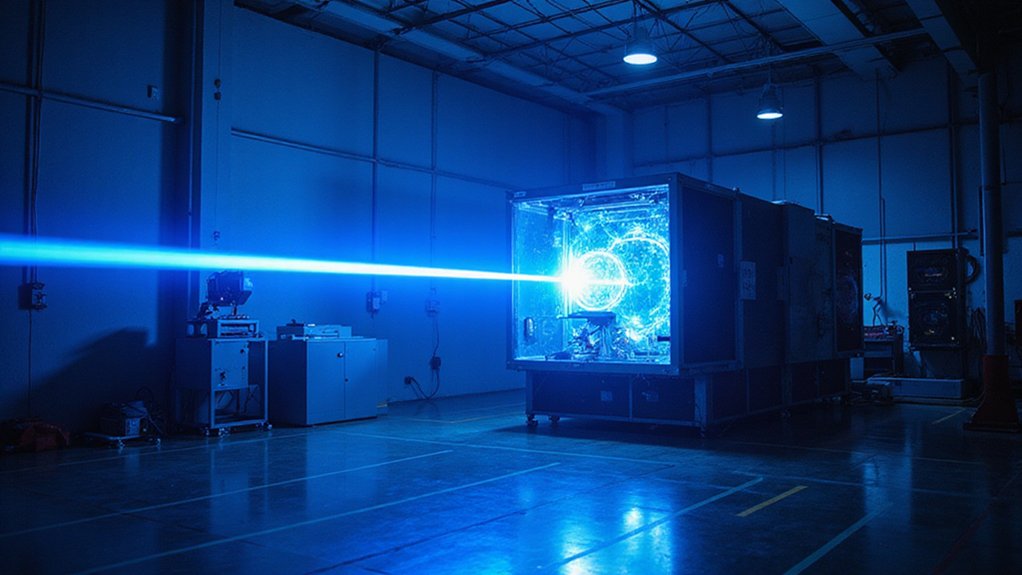
The ZEUS laser system occupies an entire gymnasium-sized facility. During operation, an initial infrared pulse is manipulated through special optical devices called diffraction gratings. The beam grows to 12 inches across and several feet in length before reaching its maximum power. In the final phase, the beam width is reduced to less than a micron to achieve its full power potential.
Housing a scientific marvel that spans a gymnasium, ZEUS transforms a tiny infrared pulse into a foot-wide beam of unprecedented power.
In its first demonstration, the team fired the laser into a chamber filled with helium gas. The laser’s intense energy stripped electrons from helium atoms, creating plasma. This process, called wakefield acceleration, pushes electrons behind the laser pulse to extremely high velocities.
Karl Krushelnick, director of the center, leads a team of research scientists in Electrical and Computer Engineering who operate the massive system. They’re already planning more advanced experiments for later in 2025. One upcoming test will collide accelerated electrons with laser pulses from the opposite direction, making the 3-petawatt laser appear a million times more powerful.
The ZEUS system opens new frontiers for American high field science that weren’t possible before due to power limitations. Its potential applications are vast, including advances in medicine, national security, materials science, and fusion energy experiments. The system utilizes an 18cm sapphire crystal infused with titanium atoms that took four and a half years to manufacture.
ZEUS is the successor to the university’s previous HERCULES system, which had a maximum output of 300 terawatts—just 15% of ZEUS’s current power.
References
- https://cosmosmagazine.com/science/physics/zeus-a-mighty-laser-fires-into-the-future/
- https://thedebrief.org/worlds-most-powerful-laser-zeus-equips-u-s-with-beam-surpassing-100x-global-electric-power-output/
- https://www.popsci.com/science/united-states-most-powerful-laser-zeus/
- https://zeus.engin.umich.edu/about/
- https://news.engin.umich.edu/2025/05/the-us-has-a-new-most-powerful-laser/