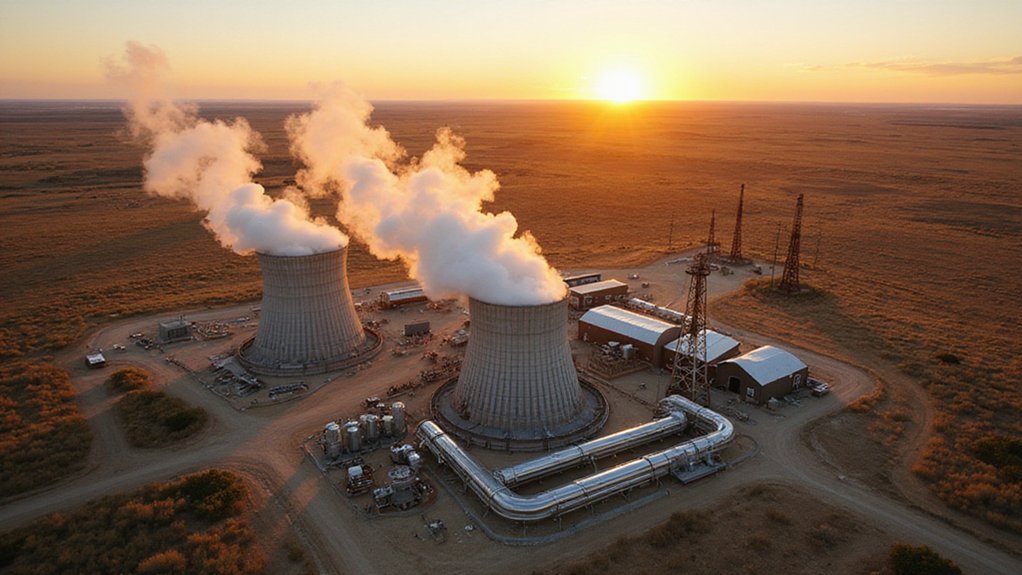
The Netherlands is tapping into Earth’s heat to warm homes and businesses. Geothermal wells in the country are now reaching temperatures around 90°C at depths near 2,800 meters. This achievement represents a significant step in the nation’s renewable energy strategy.
Deep below the surface, the Netherlands maintains a stable temperature gradient of approximately 30°C per kilometer. Engineers drill wells between 1,500 and 4,000 meters deep to access hot water trapped in underground aquifers. The deeper the well goes, the hotter the water becomes. At 2,800 meters, temperatures consistently hit the 90°C mark, with some wells reaching maximum temperatures around 100°C.
The drilling technique used involves well pairs called doublets. One well pumps hot groundwater to the surface while a second well injects cooled water back into the same aquifer. These production and injection wells sit approximately one to two kilometers apart. This distance prevents cooled water from returning too quickly to the production well, which would reduce efficiency. Before any production begins, a production plan must be submitted to and approved by the Minister.
The hot water comes from highly permeable and porous aquifer layers. These water-bearing strata contain porous sand and stone saturated with warm salt water. The Rotliegend aquifer at around 2,200 meters depth serves as a major source for deep geothermal supply. Other layers like the Maassluis Formation at shallower depths also contribute to the system. Research wells across multiple locations, including Strandeiland and other SCAN program sites, are systematically evaluating subsurface formations to identify optimal geothermal extraction zones throughout the country.
Production volumes can reach up to several hundred cubic meters per hour. Heat exchangers transfer this warmth to tap water for heating networks serving greenhouses, homes, businesses, and industries. The cooled water gets injected back at temperatures of 35°C or lower, maximizing heat extraction efficiency.
The Netherlands has set an ambitious target. The nation aims for geothermal energy to contribute roughly 230 petajoules to its heat network. This renewable heat source offers a constant, stable supply unlike seasonal energy sources. A doublet system has an estimated technical lifespan of approximately 30 years. Unlike solar or wind power, geothermal energy maintains a near 95% availability factor, delivering uninterrupted heat regardless of weather conditions or time of day.
Future developments include exploring the potential for even deeper aquifers beyond 4,000 meters. These ultra-deep geothermal wells could reach temperatures exceeding 100°C. Enhanced Geothermal Systems could involve fracking to improve fluid flow in these extreme depths. The Netherlands continues advancing this technology to meet growing heating demands sustainably.
References
- https://www.nlog.nl/en/geothermal-energy
- https://www.thinkgeoenergy.com/geothermal-research-drilling-in-strandeiland-netherlands-reaches-target-1963m-depth/
- https://energy.nl/data/geothermal-heat-production-deep-1500/
- https://geoexpro.com/the-first-high-temperature-aquifer-thermal-energy-storage-project-in-europe/
- https://geothermiedelft.nl/en/about-geothermal-energy
- https://www.lbeg.niedersachsen.de/download/52200/Geothermal_energy_use_in_the_Netherlands.pdf
- https://publications.tno.nl/publication/34632176/5j1C7E/o12043.pdf
- https://geothermie.nl/images/bestanden/Masterplan_Aardwarmte_in_Nederland_ENG.pdf