
After a quarter-century of promises, bulldozers, and billions of dollars, the Extensive Everglades Restoration Plan finally has something to show for itself. The year 2025 marks CERP’s 25th anniversary, and the progress—while painfully slow for the first decade—is finally visible. One completed project, two major components finished, another fundamentally done, and six under construction. Not exactly speedy, but hey, it’s government work.
Record funding has been the game-changer. President Trump’s FY2026 budget includes $446 million for restoration—the largest presidential recommendation yet. Florida’s chipping in too, with a whopping $810 million to accelerate projects. Money talks, and the Everglades is listening.
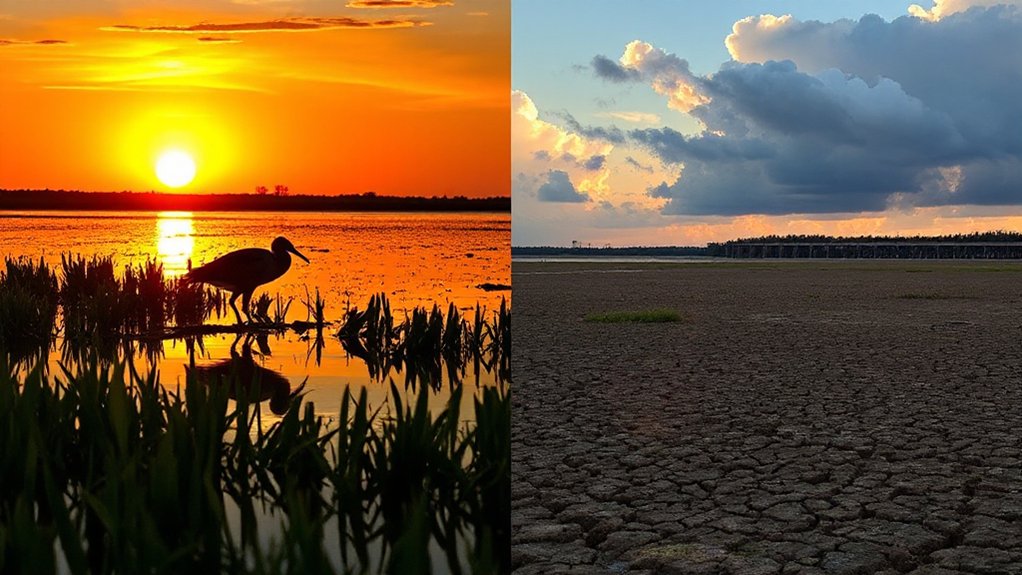
The transformation is happening region by region. Increased water flows into northeast Shark River Slough represent the biggest step toward restoring central Everglades hydrology. The Tamiami Trail—once a dam-like barrier across the River of Grass—now has elevated sections allowing water to flow underneath. Nature doesn’t care about your scenic highway, folks.
Water finally flows where it should. The River of Grass reclaims its rightful path, human barriers be damned.
Invasive species control is working. Melaleuca trees, those thirsty Australian imports, have been reduced by 75%. The Picayune Strand Restoration Project is breathing life back into 55,000 acres of native wetlands. Miller Pump Station reached start-up phase this year, with completion set for early 2026.
The crown jewel remains the EAA Reservoir. When completed in 2029 (accelerated from 2034), it’ll provide 370,000 acre-feet of “new” freshwater—enough to flood 578 square miles with a foot of water. The $3.5 billion reservoir will be the largest constructed wetland designed to filter pollutants before water enters the Everglades. Water that would’ve been wasted to sea will now nourish the ecosystem.
It wasn’t always this promising. Lack of funding during CERP’s first years stalled progress. Now projects are underway throughout the system, from the Kissimmee River to Biscayne Bay Coastal Wetlands. The Everglades Foundation has championed these efforts with over 30 years of dedicated advocacy and scientific expertise. Restoration efforts now include exploring geothermal systems to power pumping stations with renewable heat energy that operates consistently regardless of weather conditions.
Twenty-five years in, the Everglades restoration is finally delivering results. Not a moment too soon for an ecosystem that’s been on life support for decades. Florida’s liquid heart is beating stronger.
References
- https://insideclimatenews.org/news/01012026/25-years-of-everglades-restoration/
- https://www.evergladesfoundation.org/post/official-statement-on-2026-presidential-budget-recommendation-for-everglades-restoration
- https://www.sfwmd.gov/news-events/news/we-wrap-2025-we-take-look-outstanding-district-accomplishments-everglades
- https://wastewatervisibility.com/protecting-florida-together-2025-progress-2026-goals/
- https://www.evergladesrestoration.gov/progress-report-1
- https://www.flhouse.gov/Sections/Bills/billsdetail.aspx?BillId=83326
- https://www.evergladesrestoration.gov
- https://www.nationalacademies.org/units/DELS-WSTB-23-P-517/projects
- https://www.nationalacademies.org/projects/DELS-WSTB-24-01
- https://www.congress.gov/crs_external_products/IF/HTML/IF11336.web.html