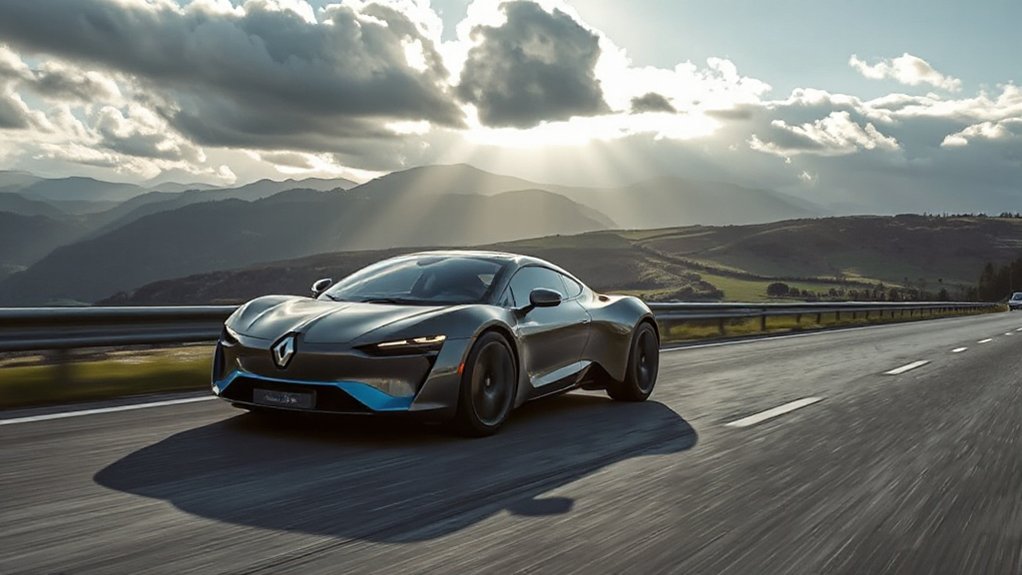

Renault’s sleek electric prototype, the aptly-named ‘Filante’ (French for “shooting star”), just blew past every EV efficiency record on the books. The radical car crushed expectations by traveling a mind-boggling 1,008 kilometers on a single charge, all while maintaining highway speeds averaging 102 km/h. Not your grandmother’s slow-moving eco-box, that’s for sure.
The secret? Obsessive aerodynamic optimization. Engineers became wind-tunnel hermits, completely reshaping the car’s silhouette to achieve an insanely low drag coefficient. They created a long, narrow profile with smooth shifts between the central cell and body panels. Those weird wheel fairings aren’t just for show—they actually work.
Aerodynamic obsession turned engineers into wind wizards, sculpting every curve for maximum efficiency.
Weight reduction bordered on fanatical. The team slashed mass to roughly 1,000 kg using carbon-fiber, aluminum alloys, and fancy 3D-printed Scalmalloy components. They ditched traditional mechanical systems for steer-by-wire and brake-by-wire setups. No cushy seats or luxury amenities here—just the bare essentials.
Surprisingly, the ‘Filante’ doesn’t rely on some magical new battery technology. It uses the same 87 kWh pack found in the production Renault Scenic E-Tech. The collaboration with Ligier for vehicle construction helped optimize integration of the battery components for better weight distribution and efficiency. The front-motor layout mirrors the Scenic’s basic architecture but prioritizes efficiency over raw power. When the Filante crossed the finish line, it still had 11% charge left. Not too shabby.
Michelin developed custom tires specifically for this record attempt, balancing minimal rolling resistance with high-speed stability. This exceptional engineering translated to an impressive 174.6 MPGe rating, far exceeding the efficiency of top production EVs. Every auxiliary system was reimagined to reduce energy consumption. This project highlights how technological advancements in renewable transportation are helping address the global shift away from fossil fuels.
The record run took place at Morocco’s UTAC 30 km test track in Oued Zem, chosen for its long, smooth stretches that simulate continuous highway driving. The result? A jaw-dropping consumption figure of just 7.8 kWh/100 km.
While you won’t see the Filante at your local Renault dealer anytime soon, it proves what’s possible when engineers obsess over efficiency. Range anxiety? Please. This thing could practically drive from Paris to Barcelona without stopping.
References
- https://www.autoweek.com/news/a69853170/this-electric-vehicle-just-set-an-electric-efficiency-record/
- https://www.renaultgroup.com/en/magazine/our-group-news/outstanding-energy-efficiency-with-filante-record-2025/
- https://www.renault.co.uk/concept-cars-range/z41-filante-demo-car.html
- https://www.youtube.com/watch?v=XuavUktMnOA
- https://electrek.co/2025/12/27/renault-group-closes-out-2025-with-a-new-ev-efficiency-record/
- https://www.carexpert.com.au/car-news/renault-concept-completes-1000km-run-in-10-hours-without-recharging
- https://www.electrifying.com/blog/article/renault-sets-new-ev-efficiency-record