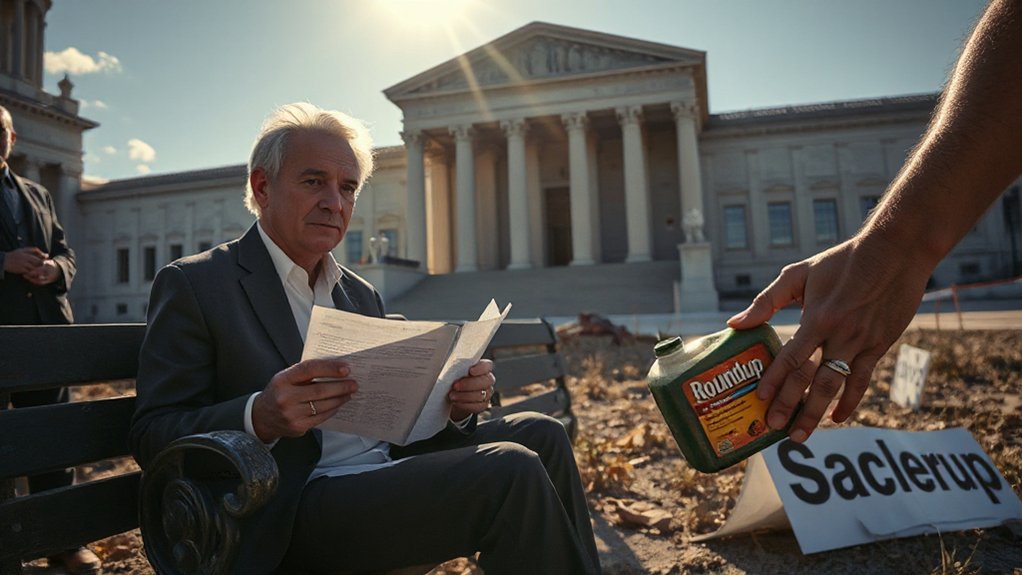

As the Supreme Court prepares to hear arguments in Monsanto Co. v. Durnell, thousands of cancer patients nationwide hold their breath. The high-stakes legal showdown centers on a deceptively simple question: Does federal pesticide law trump state-level failure-to-warn claims about Roundup’s cancer risks?
It’s not just another technical legal dispute. Nearly 200,000 claims have been filed alleging Roundup causes non-Hodgkin lymphoma. The Supreme Court’s decision could either extinguish these lawsuits or green-light their continuation. Talk about life-changing power in nine people’s hands.
For thousands of Roundup plaintiffs, nine justices hold the power to validate or vanquish their quest for justice.
Monsanto, backed by the U.S. Solicitor General, argues EPA-approved Roundup labels without cancer warnings effectively block state tort claims demanding such warnings. Their logic? Federal law preempts state requirements. Case closed, they hope.
Meanwhile, cancer patients keep winning in lower courts. Just look at the numbers. $611 million in Missouri. Over $2 billion in Georgia. $2.25 billion (later cut to $400 million) in Pennsylvania. These aren’t small-change verdicts.
The science sits at the center of this legal tornado. In 2015, the International Agency for Research on Cancer classified glyphosate – Roundup’s active ingredient – as “probably carcinogenic to humans.” Bayer, which bought Monsanto, vehemently disagrees. They’ve never stopped insisting their weed killer is safe.
Preemption arguments aren’t sexy, but they’re powerful legal weapons. If Monsanto wins, thousands of plaintiffs could effectively lose their day in court. If they lose, the floodgates stay open for more massive verdicts and settlements. Due to high traffic to the court’s website, many plaintiffs have been unable to access critical case documents, adding another layer of anxiety to their already stressful situation.
For Terry Durnell, who won $1.25 million in Missouri, this case is deeply personal. But it’s also a test of corporate accountability versus federal regulatory authority. Can companies hide behind EPA approvals when state laws might demand more transparency?
The Court’s ruling won’t just impact Roundup cases. It could reshape how federal and state laws interact across industries. Bayer has already paid out nearly $11 billion in settlements across approximately 100,000 resolved claims. For thousands of cancer patients awaiting justice, it’s literally a life-or-death decision.
References
- https://www.lawsuit-information-center.com/roundup-lawsuit.html
- https://www.sokolovelaw.com/product-liability/monsanto-roundup/lawsuit-updates/
- https://www.millerandzois.com/products-liability/roundup-cancer-lawsuits/
- https://www.motleyrice.com/toxic-exposure/roundup-lawsuits
- https://www.scotusblog.com/2026/01/scotustoday-for-thursday-january-8/
- https://beyondpesticides.org/dailynewsblog/2026/01/bayer-monsanto-legislation-to-stop-lawsuits-for-failing-to-disclose-product-hazards-stalls-in-house/
- https://www.dtnpf.com/agriculture/web/ag/news/article/2026/01/06/pesticide-immunity-provision-dropped