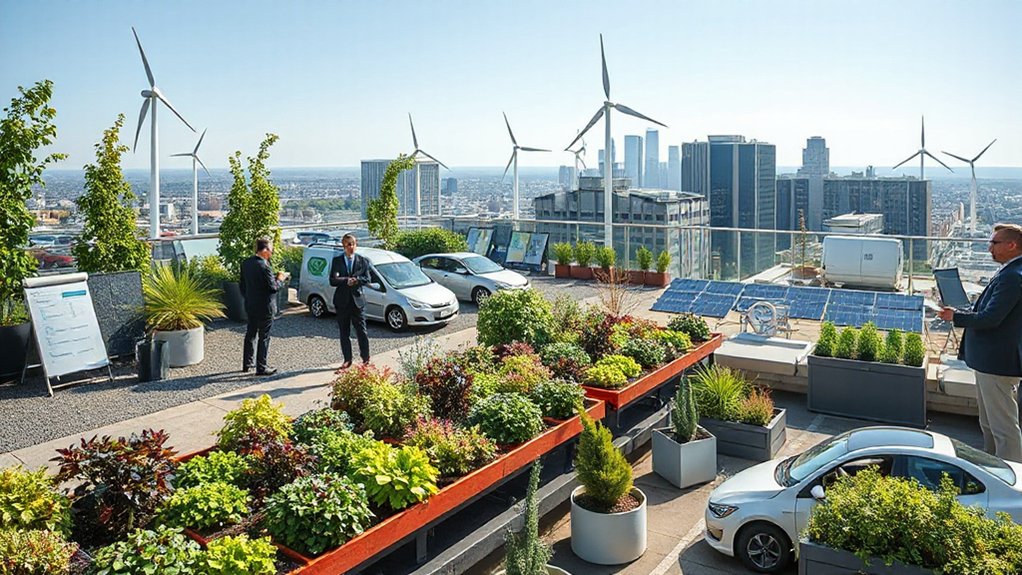

While corporations once treated sustainability as window dressing, the business landscape of 2025 has undergone a seismic shift. Companies can’t just slap a green logo on their products anymore and call it a day. Consumers aren’t buying it—literally. A whopping 70% prefer companies with environmentally responsible practices, and 60% will pay extra for sustainable products. Money talks, and it’s speaking the language of planet Earth these days.
Regulators aren’t playing around either. The Corporate Sustainability Reporting Directive is forcing over 50,000 EU companies to cough up more than 1,000 sustainability metrics by 2025. Even California—yes, that sunny state—passed climate disclosure laws affecting businesses nationwide. ESG-mandated assets are projected to hit $35 trillion this year. That’s trillion with a “T,” folks. The Ecodesign for Sustainable Products Regulation is forcing companies to use sustainable materials for easier reuse and recycling.
The numbers don’t lie. In 2024, 91% of companies by market capitalization disclosed sustainability information, up from 86% in 2022. Nearly all G250 companies (95%) now publish carbon targets. Impressive? Sure. Enough? Hardly.
Some corporations are putting their money where their mouth is. About 56% of G250 companies have designated sustainability leaders, and 41% link executive compensation to sustainability metrics. About time!
Meanwhile, 45% of Fortune 500 companies plan to achieve net zero by 2050. Better late than never, right?
Of course, there are headwinds. U.S. federal rollbacks have thrown a wrench in climate disclosure efforts. Corporate silos remain a pain, with 24% of companies citing them as barriers to ESG agendas. And anti-ESG sentiment has even the big-shot CEOs sweating.
But innovation marches on. The circular economy is gaining steam with extended producer responsibility legislation in seven states. The average consumer is now willing to pay 9.7% more for sustainable products, showing the market is responding to climate concerns. The historic milestone of renewable energy dominance in March 2025, when renewables supplied 50.8% of U.S. electricity for the first time, has further accelerated corporate sustainability commitments. AI is revolutionizing data visibility, and sustainability teams are finally getting seats at the table with finance and legal departments.
Despite the naysayers, sustainability isn’t just surviving—it’s thriving. And that’s no greenwashed corporate statement.
References
- https://federalinternational.com/articles/sustainable-insights/what-are-the-latest-trends-in-corporate-esg-2025/
- https://greenplaces.com/articles/50-essential-sustainability-statistics-for-2025/
- https://corpgov.law.harvard.edu/2025/06/24/top-10-corporate-sustainability-priorities-for-2025/
- https://www.venasolutions.com/blog/esg-statistics
- https://www.keyesg.com/article/50-esg-statistics-you-need-to-know
- https://www.oecd.org/en/publications/2025/10/global-corporate-sustainability-report-2025_57b105f2.html
- https://atrius.com/state-of-corporate-sustainability-2025/
- https://environenergy.com/2025/07/whats-next-for-corporate-sustainability-trends-tensions-and-the-quiet-momentum-ahead/
- https://www.generationim.com/media/5milmzsd/generation_the_sustainability_trends_report_2025.pdf
- https://instituteofsustainabilitystudies.com/insights/lexicon/sustainability-trends-for-2025-and-predictions-for-2026/