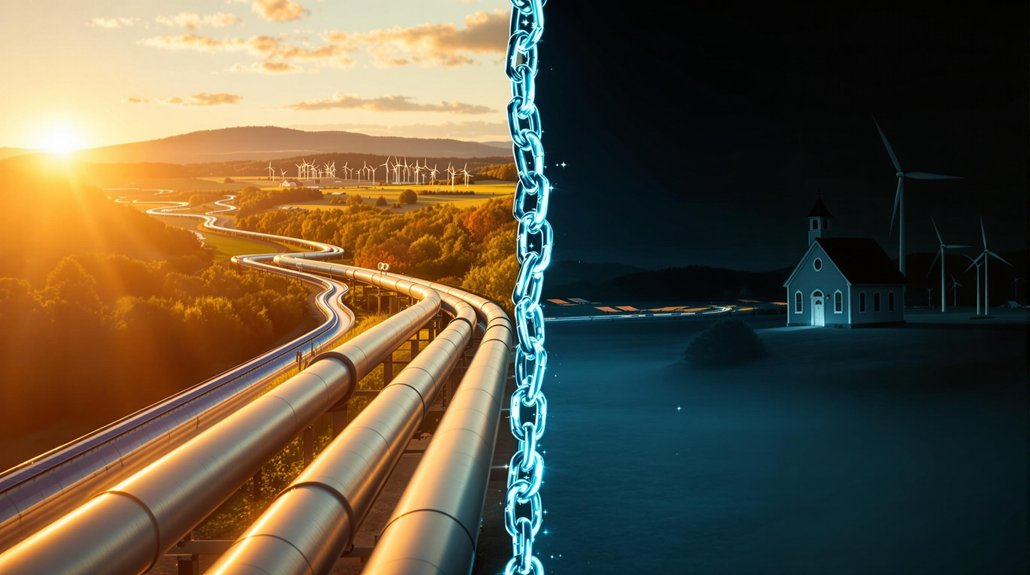
At the Davos World Economic Forum on January 21, 2026, President Trump announced an ambitious plan aimed at enabling faster nuclear power plant approvals for tech companies building artificial intelligence data centers. The proposal would potentially allow Silicon Valley firms to build their own nuclear power plants to supply electricity to their AI operations. Trump claimed the idea originated with him, noting that tech executives have the money and skills to construct power plants.
Trump’s plan empowers Silicon Valley to build private nuclear plants for AI data centers, dramatically accelerating federal approval timelines.
The administration’s plan dramatically shortens the approval process. Nuclear projects would receive approval in as short as three weeks, while oil and gas projects would be approved in two weeks. This bypasses the traditional Nuclear Regulatory Commission process, which typically requires four to five years. Recent examples show small modular reactors can take under two years through the standard NRC process. The expedited timeline has raised concerns about safety and environmental protections.
AI data centers demand enormous amounts of electricity. According to industry reports, these facilities are projected to require massive increases, potentially rivaling significant portions of U.S. supply. Reports indicate around 46 U.S. sites plan on-site power plants, with most using natural gas despite tech companies’ clean energy promises. Each facility requires over 100 megawatts of new power, equivalent to the electricity needs of a medium-sized city. The administration has positioned grid strain as a central economic and national security risk for 2026.
Amid industry discussions, tech leaders initially showed some skepticism about the plan but were assured the government would deliver. Major technology companies have reportedly committed to supplying their own power, with some making pledges at the White House. Anthropic reportedly pledged to cover 100 percent of any electricity price increases for consumers caused by its data centers. This protects American ratepayers from higher electricity bills. The pledge represents a ratepayer protection commitment amid White House efforts to coordinate with major technology firms.
The nation’s aging electrical grid isn’t ready for AI’s power demands. Grid expansion costs are substantial. Estimated costs run into the billions — reportedly around $3.1 billion for the PJM Interconnection alone, which serves several eastern states, with individual states facing significant bills: Illinois an estimated $637 million, Pennsylvania roughly $647 million, and Virginia approximately $1.4 billion. Globally, dozens of reactors under construction worldwide are currently being built, with many located in developing countries seeking affordable low-carbon energy solutions.
Some tech companies already use creative power solutions. Elon Musk’s xAI deployed unpermitted mobile generators in Tennessee and Mississippi. The White House policy accelerates federal permitting for data centers to help the U.S. compete with China in AI development. Trump shifted his position on nuclear energy, now calling it safe and affordable.
References
- https://fortune.com/2026/01/21/trump-davos-nuclear-power-plant-approval-data-centers-ai-race-energy/
- https://www.businessinsider.com/data-centers-on-site-power-plants-trump-announces-2026-2
- https://www.theregister.com/2026/01/21/american_genius_says_dont_panic/
- https://www.politico.com/news/2026/03/04/trump-ai-data-centers-electricity-00811909
- https://www.whitehouse.gov/presidential-actions/2025/07/accelerating-federal-permitting-of-data-center-infrastructure/