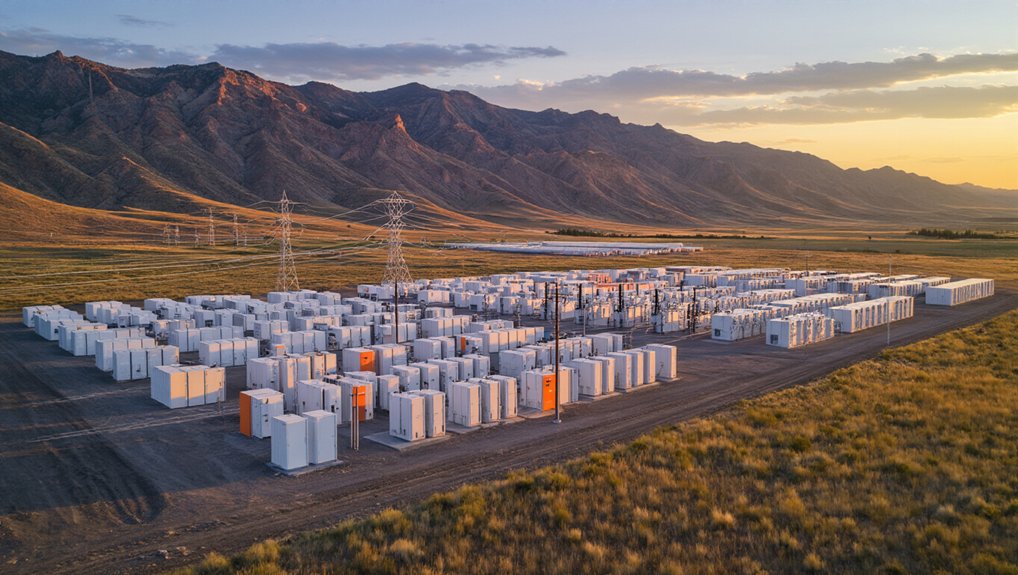
What happens when factories can make more batteries than the country needs? That’s the question facing America’s booming battery manufacturing sector. U.S. factories have reached 70 GWh of annual capacity for grid storage systems by the end of 2025. However, domestic demand isn’t keeping pace with this explosive growth.
U.S. battery factories have already reached 70 GWh of annual capacity, yet domestic demand isn’t keeping pace with this explosive growth.
The numbers tell a striking story. Energy storage installations hit a record 57.6 to 58 GWh in 2025. Projections for 2026 show installations climbing to 70 GWh, a 21% increase. Yet U.S. factories can already produce far more. Analysts predict a 10% surplus of FEOC-compliant capacity in 2026, meaning the country will have more battery-making ability than it needs.
This oversupply happened quickly. The Inflation Reduction Act sparked a wave of factory announcements from manufacturers worldwide. Companies like LG Energy Solution in Michigan and AESC in Tennessee already operate lithium-ion battery plants retooling for ESS. SK Battery America in Georgia and Samsung SDI in Indiana plan to start production in 2026. Meanwhile, Ford is among companies that intend to convert EV manufacturing lines for stationary storage production. EV battery lines are being repurposed with LFP chemistries to meet grid storage requirements.
The supply situation is even more complex because of international competition. Korean suppliers are reportedly expected to provide a dominant share of FEOC-compliant energy storage cell capacity. Korean EV plants typically operate below full capacity, meaning they’ve got extra room to shift production toward American energy storage needs.
Despite the surplus, demand is still growing. Utility-scale storage saw major additions, contributing to record 58 GWh total installs in 2025. Commercial and industrial storage reached 2.61 GWh, while residential storage totaled 3.1 GWh. Roughly examples of large projects over 600 MW — such as Lunis Creek at an estimated 621 MW and Clear Fork Creek at around 600 MW — are planned for 2026. Battery storage expansion is expected to reach 24.3 GW in 2026, continuing the five-year trend of exponential growth.
Looking ahead, U.S. battery makers aim to eventually supply 100% of domestic grid battery demand. The key driver remains clear: electricity demand is rising while battery costs continue falling. Solar and wind energy need battery storage to work reliably. Renewables and storage are projected to make up roughly 93% of new utility-scale capacity additions in 2026. That’s why factories keep expanding, even as today’s surplus suggests they’ve gotten ahead of themselves.
References
- https://www.pv-magazine.com/2026/02/26/solar-storage-to-lead-record-86-gw-of-us-capacity-in-2026/
- https://www.solarpowerworldonline.com/2026/01/almost-overnight-the-us-became-an-oversupply-market-for-ess-battery-cells/
- https://www.gurufocus.com/news/8642772/us-battery-market-seen-growing-21-as-installs-hit-70-gwh
- https://www.renewableenergyworld.com/energy-storage/battery/a-new-record-us-added-58-gwh-of-new-energy-storage-capacity-in-2025/
- https://www.canarymedia.com/articles/clean-energy-manufacturing/us-capacity-storage-cell-factories
- https://seia.org/news/united-states-installs-58-gwh-of-new-energy-storage-in-2025/