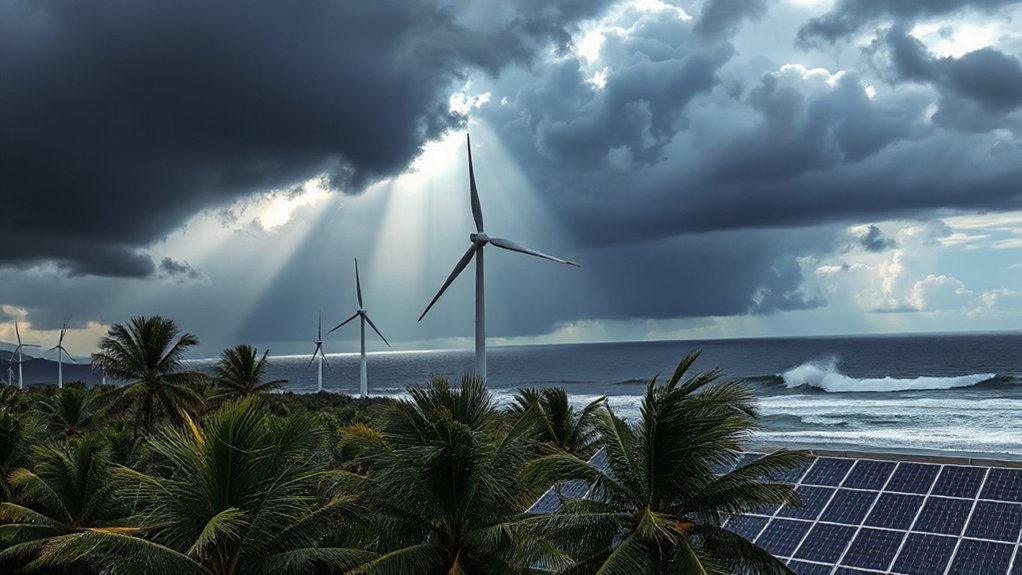
As the U.S. pushes to expand clean energy sources, offshore wind is experiencing rapid growth. The total U.S. offshore wind pipeline has reached 80,523 MW as of May 31, 2024, representing a large 53% increase from the previous year’s report. This expansion adds 27,836 MW of new capacity across various development stages.
The U.S. offshore wind pipeline reached 80,523 MW as of May 2024, marking a substantial 53% increase year-over-year.
Currently, the U.S. has 174 MW of operational offshore wind capacity from three fully functional projects. The South Fork Wind Farm, which became fully operational on March 14, 2024, contributes 132 MW to this total. These projects mark the beginning of large-scale offshore wind deployment in American waters.
Construction is actively underway on several major projects totaling 4,097 MW. Vineyard Wind 1 is progressing with 806 MW of capacity, while Evolution Wind adds 704 MW. The Coastal Virginia Offshore Wind project represents the largest under-construction facility at 2,587 MW. Overall, approximately 5-6 GW of capacity is currently under construction across the nation. Converting this substantial pipeline into operational assets remains the industry’s immediate test for building investor confidence and demonstrating momentum toward grid-scale deployment.
Recent lease additions have greatly boosted the pipeline. Eight Gulf of Maine lease areas contributed 15,702 MW, while four Gulf of Mexico lease areas added 6,638 MW. Two Mid-Atlantic lease areas provided 4,499 MW, and two Oregon coast lease areas added 3,156 MW. These new leases demonstrate expanded geographic diversity in offshore wind development. Several canceled projects, including up to eight, have reportedly explored alternative offtake pathways due to cost escalation and market volatility affecting financial viability.
Floating offshore wind technology is becoming increasingly important to the pipeline’s growth. As of May 31, 2024, the U.S. has 25,116 MW of floating offshore wind capacity in development. California leads with over 6,000 MW from five floating projects, while the Gulf of Maine floating pipeline exceeds 15,000 MW across eight leases.
The permitting stage shows strong momentum, with approximately 27 GW of projects at or beyond the permitting stage. Thirty-eight projects in permitting or site control total over 42 GW of capacity. If fully developed, the current pipeline could potentially provide enough power for over 26 million homes.
Forecasts predict that the U.S. will have 40-42 GW of operational capacity by the end of 2035, representing substantial growth from today’s minimal levels.
References
- https://reglobal.org/us-offshore-wind-market-assessment/
- https://www.energy.gov/cmei/systems/offshore-wind-market-report-2024-edition
- https://docs.nrel.gov/docs/fy24osti/90921.pdf
- https://enkiai.com/offshore-wind/offshore-wind-top-10-projects-in-usa-in-2025
- https://docs.nlr.gov/docs/fy24osti/90897.pdf
- https://www.ajot.com/news/annual-reports-present-americas-growing-wind-energy-future
- https://carboncredits.com/equinors-5b-wind-project-pause-raises-concerns-for-u-s-offshore-wind-energy-industry/
- https://www.renewableinstitute.org/us-offshore-wind-pipeline-reaches-80gw/