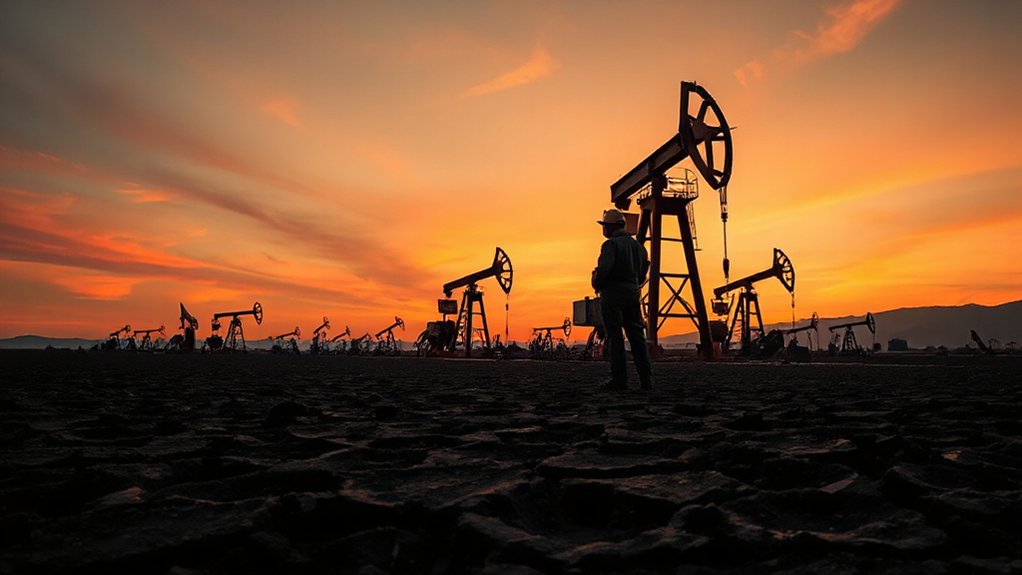
A paradox of plenty sits beneath Venezuela’s soil. The nation boasts 300 billion barrels of proven oil reserves—the world’s largest—yet produces a measly 0.8% of global crude. How’s that for irony? These aren’t your premium light, sweet barrels either. We’re talking sludge.
Venezuela’s reserve figures have always raised eyebrows. They mysteriously tripled from 100 billion barrels in the early 2000s to 300 billion by decade’s end. No major discoveries. No technological breakthroughs. Just—poof!—more oil on paper. The real story? They simply reclassified the tar-like crude in the Orinoco Belt as “proven.” This reclassification contributed significantly to the perceived enhancement of Venezuela’s oil wealth despite no actual production increases.
This isn’t your grandfather’s crude. Orinoco oil is extra-heavy stuff with API gravity between 9.5-12 and sulfur content at a nasty 4-5%. Basically liquid asphalt. Good luck pumping that through pipelines without diluting it first.
Sure, the USGS estimates there’s up to 1,400 billion barrels in the Orinoco Belt. Impressive number. But recoverable? That’s another story entirely. Even optimistic scenarios put only about half that amount as technically extractable.
Economics? Don’t ask.
The environmental scorecard is equally dismal. Venezuela’s crude has the highest greenhouse gas emissions per barrel globally. Second-highest methane intensity among major producers, too. Not exactly what the climate-conscious world is shopping for these days.
Production costs hover between $42-56 per barrel. Fields decline at 15% annually. Decades of mismanagement have gutted the infrastructure. Restoring production would require $53 billion in new investment. The mass exodus of 18,000 PDVSA workers following the 2002 strike decimated the technical expertise needed to manage these complex reserves.
Who’s lining up with checkbooks? Nobody.
Venezuela sits on an ocean of oil that nobody wants, can’t easily extract, costs too much to refine, and wrecks the climate in the process. Some treasure. The world’s moving on while Venezuela’s reserves remain largely where they’ve always been—underground and irrelevant.
References
- https://www.apolloacademy.com/venezuelas-self-reported-oil-reserves/
- https://en.wikipedia.org/wiki/Oil_reserves_in_Venezuela
- https://about.bnef.com/insights/commodities/venezuelas-oil-renaissance-faces-several-high-hurdles/
- https://insideclimatenews.org/news/07012026/venezuela-extra-heavy-oil-greenhouse-gas-emissions/
- https://www.visualcapitalist.com/how-venezuelas-oil-reserves-compare-to-the-rest-of-the-world/
- https://www.eia.gov/international/analysis/country/VEN