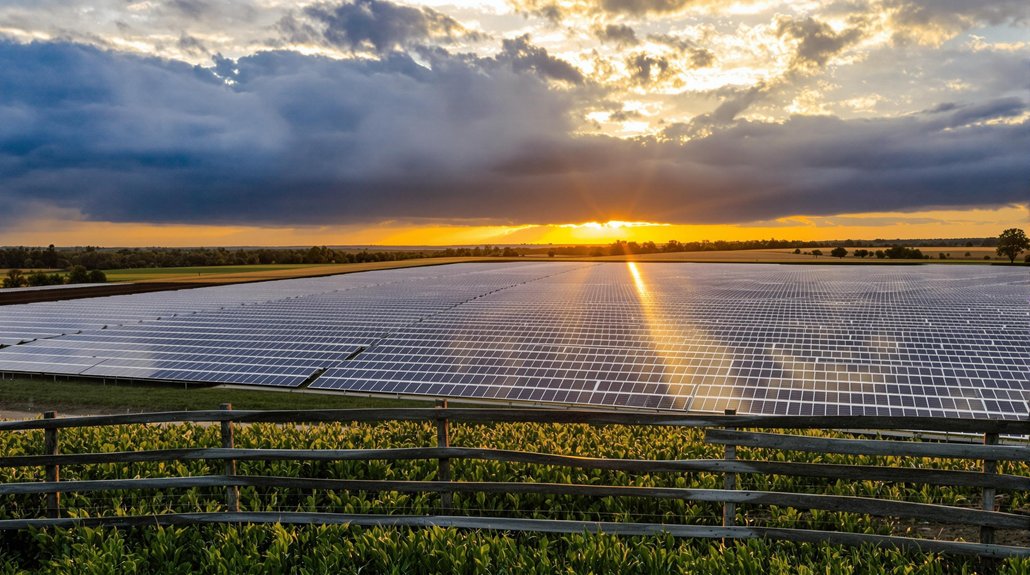
While Virginia climbs the national ranks in solar power generation—now sitting at an impressive 8th place nationwide—not everyone is celebrating this green energy transformation.
With 7,046 megawatts of installed capacity powering over 800,000 homes, solar now accounts for about 13% of the state’s electricity. That’s a lot of panels. A whole lot.
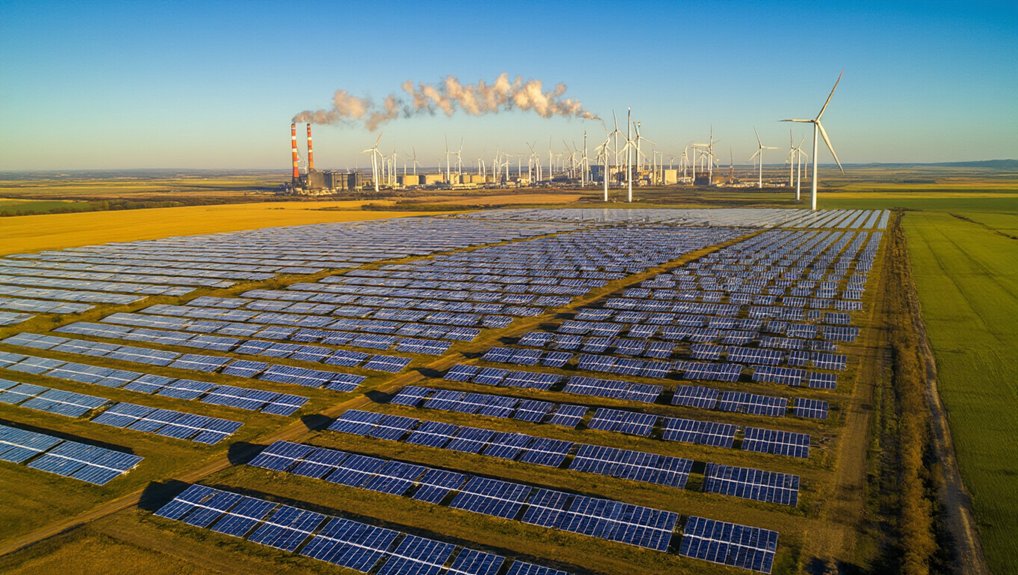
The numbers tell quite a story. Solar generation quadrupled from 1.6 million MWh in 2020 to over 6 million MWh by 2023. Great for climate goals, right? Well, someone’s gotta host all those panels. Currently, more than 30,000 acres are devoted to utility-scale solar farms, with projections suggesting this could balloon to a whopping 78,000-147,000 acres by 2035.
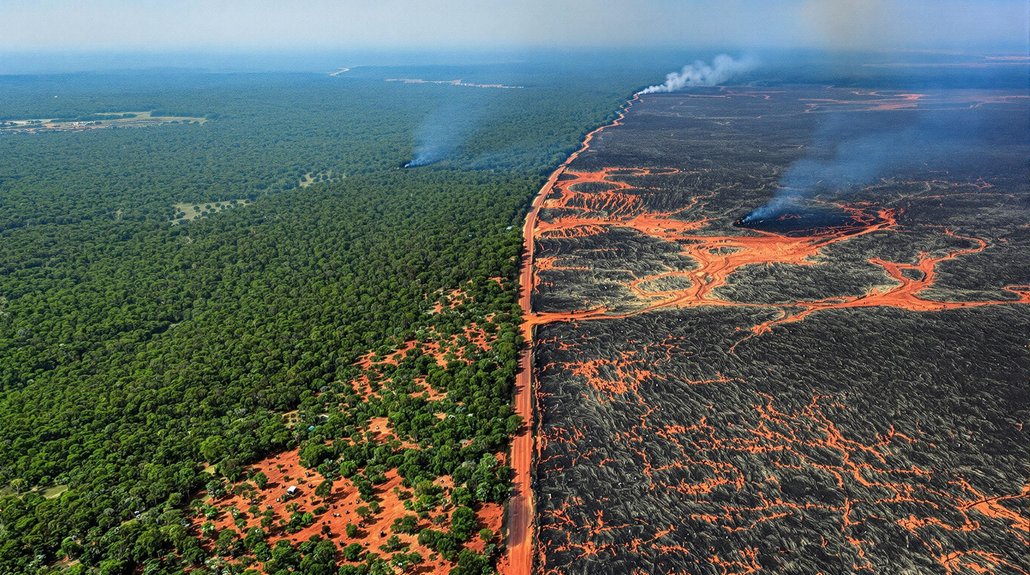
But here’s where things get sticky. Rural Virginians aren’t exactly rolling out the welcome mat. Many counties have enacted moratoria or restrictive zoning to keep solar developers at bay. Can’t really blame them. When your family has farmed the same land for generations, watching it disappear under a sea of silicon doesn’t exactly warm the heart.
The Clean Economy Act mandates 100% carbon-free electricity by 2050—the Southeast’s most ambitious climate policy. Impressive on paper. Not so simple on the ground. High-growth scenarios could convert as much as 3.1% of state cropland to solar farms by 2035. This mirrors the national trend where renewable energy surpasses traditional sources in economic efficiency, with 99% of coal plants now more expensive than solar or wind alternatives. Farmers tend to notice when their livelihood gets paved over with panels. Recent research by VCU professor Damian Pitt shows that about 28% of solar arrays were built on former cropland despite it making up only 5% of Virginia’s total land cover.
Meanwhile, the state keeps pushing forward. Solar development supports Virginia’s booming data center industry and could create up to 29,000 jobs. The state has set an ambitious energy storage goal of 3,100 MW by 2035 to complement its solar expansion. The state is also advancing shared solar and community projects through recent legislation.
The solution? Nobody really knows. The state is funding studies to assess impacts on ecosystems and local economies while trying to balance clean energy goals with local autonomy.
Solar may be clean, but this fight is getting messy. Virginia’s energy future hangs in the balance.
References
- https://news.vcu.edu/article/2025/03/vcu-researchers-assess-land-impacts-of-virginias-solar-industry–now-and-in-the-future
- https://www.energy.virginia.gov/renewable-energy/SolarPower.shtml
- https://seia.org/state-solar-policy/virginia-2/
- https://vcnva.org/clean-energy-climate-recap-2025-bill-outcomes/
- https://www.eia.gov/state/print.php?sid=VA