Even with trillions of dollars spent on renewable energy each year, a fundamental physics problem remains unsolved. The issue isn’t money. It’s power density—how much energy a technology can produce from a given area of land.
According to some estimates, coal and natural gas plants generate roughly between 100 and 2,000 watts per square meter. Solar panels, even in ideal desert conditions, produce only approximately 20 watts per square meter. Wind turbines and biofuels reach an estimated 3 and 2 watts per square meter respectively. This massive gap in power density creates problems that cash alone can’t fix.
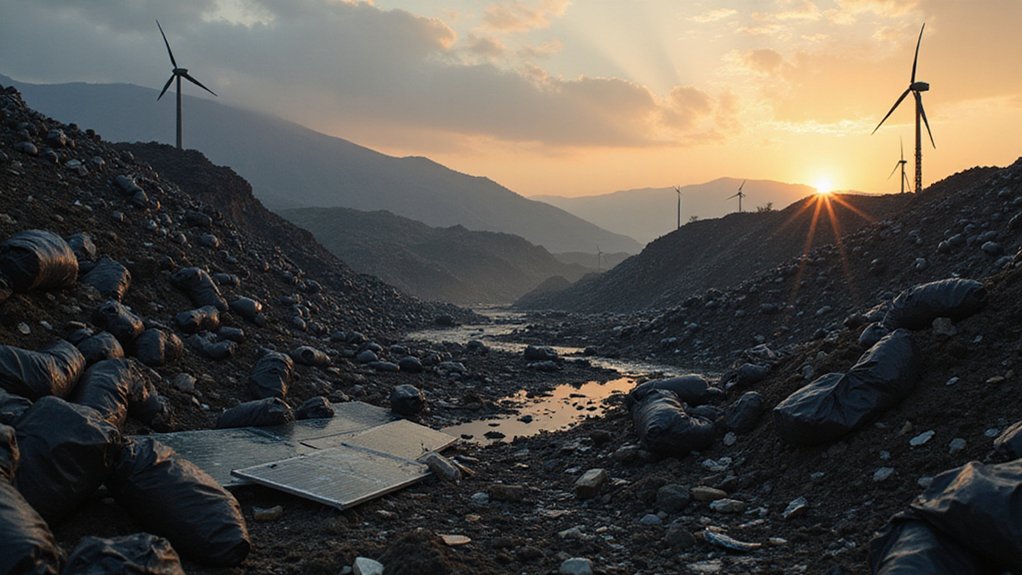
Lower power density means more land is needed to generate the same amount of electricity. To replace coal or natural gas with renewables, society would need to clear forests, convert agricultural land, and disrupt river ecosystems across enormous areas. This land requirement extends beyond just where panels and turbines sit. It includes all the mining for raw materials and infrastructure needed to support renewable systems. Clean energy systems reportedly produce power densities ranging from 0.5 to 9 W/m², which constrains their scalability compared to conventional energy sources. Fossil fuels, by contrast, achieve their high power densities because energy stored in chemical form allows concentrated generation from minimal physical footprint.
The transportation and storage challenge makes things worse. Fossil fuels are easy to move and store. Electricity isn’t. Expanding long-distance transmission infrastructure is a significant cost component of renewable transition, requiring an estimated $700 billion to double transmission capacity from 200,000 to 400,000 miles. Battery storage technologies, which could solve intermittency problems, represent what experts call the “real backbreaker” of fully renewable electrical grids. Battery storage capacity continues to expand; recent data from Texas shows solar and battery systems successfully managed peak summer demand in 2024, though scaling storage for extended multi-week periods remains challenging. Lithium-ion battery prices have reportedly dropped 87% since 2010, according to industry analysts, yet the sheer scale of storage needed to support entire national grids remains economically and physically daunting.
Intermittency presents another obstacle. While wind blows and sun shines somewhere on Earth constantly, that’s not true locally. A region might experience several days without adequate solar or wind generation. Energy storage systems must bridge these gaps, requiring advanced technology and significant spending.
The declining cost of installing solar and wind panels creates a false sense of progress. These lower installation costs mask the deeper physical limitations. Producing enough renewable energy for entire nations requires far more than supplementing existing electricity grids. It demands fundamentally different infrastructure and, by some accounts, significant land conversion alongside demand-side reductions.
Roughly four trillion dollars annually might expand renewable capacity, but it can’t overcome the physics of power density. Money addresses financial problems. Physics constraints need engineering solutions. Until renewable technologies achieve higher power densities or societies accept vast land conversion, the fundamental problem persists regardless of spending levels.
References
- https://invictussovereign.com/the-challenge-of-power-density-in-clean-energy/
- https://achemistinlangley.net/2015/01/01/on-renewables-and-compromises-intermission-energy-density-and-power-density/
- https://www.mackinac.org/blog/2025/renewables-arent-renewable
- https://lifepowered.org/power-density-why-renewables-may-not-be-the-best-choice-for-the-environment/
- https://www.texaspolicy.com/the-100-renewable-dream-a-problem-of-physics-and-scale/
- https://drexel.edu/~/media/Files/greatworks/pdf_sum10/WK8_Layton_EnergyDensities.ashx