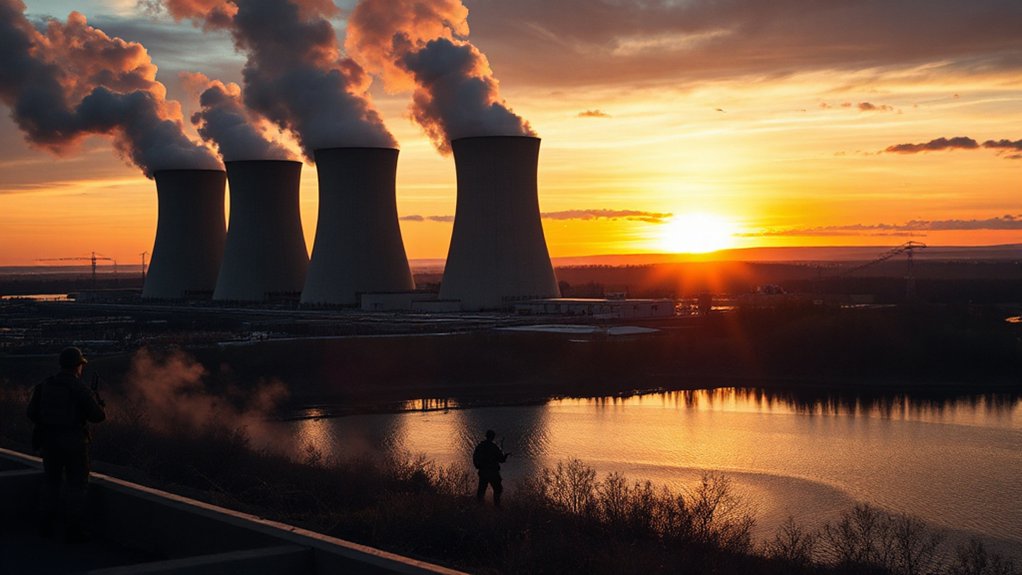

As the Zaporizhzhia Nuclear Plant teeters on the edge of its eleventh complete power disconnection since Russia seized control in 2022, nuclear safety experts are raising alarms about the facility’s increasingly precarious condition.
The recent loss of connection to the main 750 kV Dniprovska transmission line on November 14, 2025, has left the massive nuclear complex relying on a single backup line. Just one more snapped cable away from disaster. Awesome.
Before the war, ten different power lines kept Europe’s largest nuclear plant humming safely. Now? Just two measly lines. One primary, one backup. The math isn’t complicated. The plant has already experienced ten complete blackouts since Russian forces moved in. That’s ten times too many for comfort.
When the last remaining 750 kilovolt line was severed on September 23, 2025, the facility was forced to run on emergency diesel generators for weeks. These generators weren’t designed for long-term operation. They’re the nuclear equivalent of those emergency phone chargers that get you through a day when you’ve forgotten your real one. Not exactly a permanent solution.
IAEA Director General Rafael Grossi didn’t mince words on October 15, calling the situation “unsustainable.” Sure, inspections confirmed the generators are working properly, and radiation levels remain normal. But let’s not kid ourselves. Running a nuclear power plant on backup power is like driving cross-country on a donut spare tire. It might work, but nobody’s happy about it.
Ukrainian engineers have been busy, completing 42 repair operations since the invasion began. Recent work finished in late October under a fragile ceasefire agreement. Both sides blame each other for the damage. Shocking.
While all six reactors remain shutdown, they still require constant cooling—along with massive spent fuel pools. Without reliable external power, the emergency systems protecting millions across Eastern Europe depend entirely on diesel generators never meant for marathon running. Recent consultations in Kaliningrad between Russia and the IAEA failed to produce concrete solutions for long-term security. The emergency teams now operate from a new off-site facility established in Enerhodar due to the conflict. Some backup plan. The clock keeps ticking.
References
- https://www.ans.org/news/article-7472/update-on-zaporizhzhia/
- https://english.news.cn/20251114/cecf3d3f263c45eaa81219dcb497f741/c.html
- https://united24media.com/latest-news/zaporizhzhia-nuclear-plant-loses-main-power-line-raising-safety-fears-13451
- https://www.world-nuclear-news.org/articles/external-power-restored-to-zaporizhzhia-nuclear-plant-after-30-days
- https://www.pravda.com.ua/eng/news/2025/11/14/8007355/
- https://www.arabnews.com/node/2622734/world