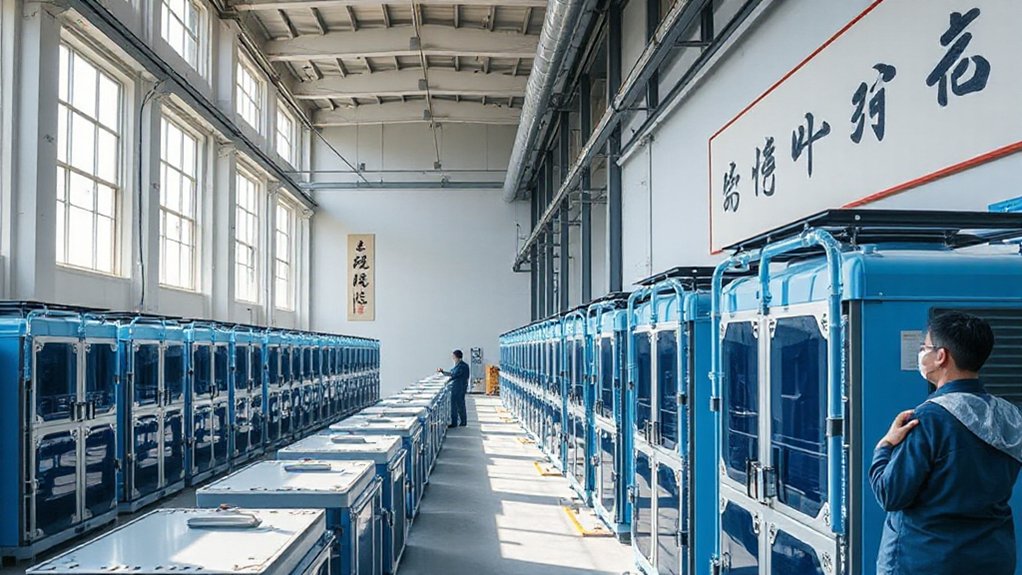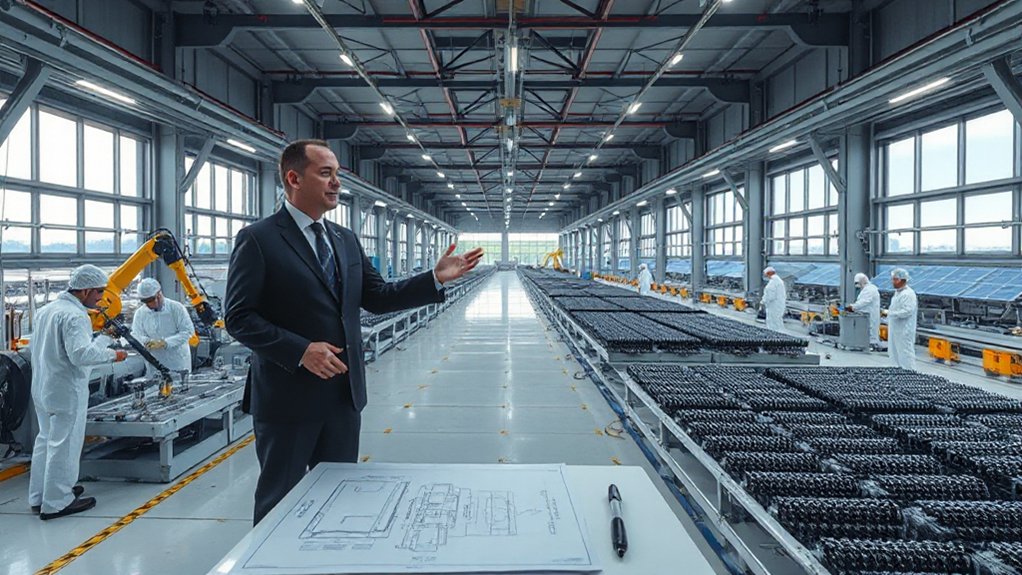

While China’s solar manufacturers have long dominated global panel production, they’re now muscling into the battery storage market with shocking speed. The numbers don’t lie. China’s battery market, valued at $49.66 billion in 2025, is expected to triple to $144.78 billion by 2032. Good luck competing with that growth trajectory.
Chinese firms already control a staggering 80% of global lithium-ion cell manufacturing. Not just a little ahead—dominating.
Chinese battery dominance isn’t incremental—it’s overwhelming, with 80% control of global lithium-ion cell production.
Look at the solar landscape first. Jinko Solar leads with 13% of global shipments, followed by Longi, Trina Solar, and JA Solar—each hovering around 11%. These aren’t small operations. Longi boasts 150 GW of production capacity; Jinko has 130 GW. They’ve mastered scale in a way Western companies can only dream about.
Now they’re doing the same with batteries. Seven of the top ten global battery energy storage system integrators are Chinese companies. Sungrow holds 14% market share, second only to Tesla’s 15%. CRRC isn’t far behind at 8%. Among these companies, CATL stands out as a dominant player supplying major automotive brands across the globe.
The invasion of European markets is already happening—Chinese BESS integrators increased their share by 67% in just one year. Four of Europe’s top ten battery players? Chinese. Surprise!
Only in North America have they lost ground, their market share dropping from 23% to 16%. Thank (or blame) the 41% tariffs imposed in 2025. Trade wars have consequences.
Meanwhile, China installed over 30 GW of grid-scale battery storage in 2024 alone. They’ll hit 100 GW by 2030. Their investment in battery storage jumped 69% in the first half of 2025. That’s commitment.
They’re not just scaling up—they’re innovating too. Sodium-ion batteries are moving from labs to production lines, reducing dependence on scarce materials like cobalt. HiNa Battery Technology has pilot lines running. The Chinese government has included this technology in strategic plans.
Western companies? They’re playing catch-up. And losing badly.
The top 25 manufacturers have demonstrated extraordinary growth rates, with shipments skyrocketing from 172 GW in 2021 to 687 GW by 2024, a 300% increase in just three years. This dominance comes as the U.S. anticipates a record 18.2 GW of new battery capacity in 2025, still far below China’s deployment pace.
References
- https://www.marketresearch.com/Inkwood-Research-v4104/China-Battery-Forecast-42926384/
- https://www.enerdata.net/publications/executive-briefing/solar-pv-market-report-2025.html
- https://www.energy-storage.news/chinese-firms-increase-global-bess-market-share-except-in-north-america-tesla-retains-top-spot/
- https://www.renewable-energy-industry.com/news/world/article-7027-chinas-energy-storage-market-booms-in-2025-battery-storage-capacity-exceeds-100-gw-for-the-first-time
- https://www.solarpowerworldonline.com/2025/08/latest-bess-rankings-show-teslas-global-dominance/
- https://about.bnef.com/insights/clean-energy/china-regains-number-one-spot-in-bloombergnefs-global-lithium-ion-battery-supply-chain-ranking/
- https://ember-energy.org/latest-insights/china-energy-transition-review-2025/