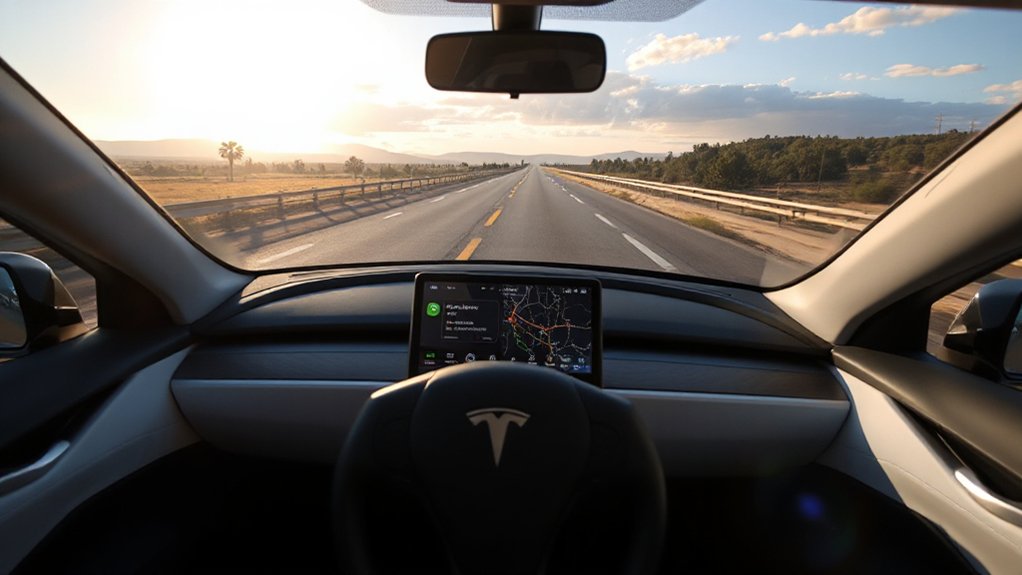
While many drivers still struggle to navigate a Costco parking lot, Tesla’s Full Self-Driving technology just completed a remarkable feat.
Tesla owner David Moss recently drove from Los Angeles, California to Myrtle Beach, South Carolina—a journey spanning 2,732.4 miles—without touching the steering wheel or pedals a single time. Not once. The cross-country trip, conducted with FSD V14.2, took just under three days—two days and 20 hours to be exact.
In a feat of robotic patience, Moss’s Model 3 conquered America without a single human correction—Pacific to Atlantic in 68 hours flat.
Moss, piloting his Model 3, claims this marks the first coast-to-coast autonomous drive across the United States. The system handled everything. Highways. City streets. Construction zones. Even those tricky interchanges that make human drivers sweat. Perhaps most impressively, the car navigated itself to Supercharging stations without human assistance.
The journey wasn’t Moss’s first rodeo with FSD. He’d already logged over 11,000 autonomous miles before starting this transcontinental adventure. But this was his first visit to the Grand Strand region of South Carolina—a new frontier for both man and machine. The achievement demonstrates significant progress from earlier versions of Tesla’s Autopilot and FSD systems.
News of the achievement exploded on X (formerly Twitter) on December 31, 2025, racking up 30 million views. Elon Musk himself acknowledged the feat, resharing Moss’s posts and igniting fresh discussions about AI and autonomy in transportation. Tech communities buzzed with excitement.
Of course, there are caveats. Tesla’s system remains technically a supervised driver-assistance program, not fully autonomous by legal definition. Moss stayed awake and alert throughout—a requirement for using the technology. And skeptics point to the lack of independent verification, complete telemetry data, or thorough footage of the journey.
Still, 2,700 miles without human intervention represents a significant milestone. No pedal touches. Zero disengagements. From the Pacific to the Atlantic, the car just…drove.
While the rest of us are still yelling at our phones for misunderstanding basic commands, Tesla’s AI just casually crossed a continent. The future, it seems, is actually arriving.
Despite the impressive nature of this journey, driver responsibility remains with the human behind the wheel at all times, as Tesla’s FSD is classified as a driver-assist feature rather than a legally recognized driverless system.
References
- https://interestingengineering.com/transportation/tesla-autonomous-trip-coast-to-coast
- https://dmnews.co.uk/tesla-owner-claims-first-fully-autonomous-coast-to-coast-drive-in-the-us/
- https://dataglobalhub.org/resource/articles/tesla-driver-reports-coast-to-coast-trip-using-full-self-driving
- https://wlos.com/news/local/man-travels-coast-to-coast-in-tesla-using-self-driving-technology-myrtle-beach-self-driving-capabilities-pedal-candy-shop
- https://supercarblondie.com/tesla-fsd-coast-to-coast-road-trip-across-the-us/
- https://www.youtube.com/watch?v=_sslDBL6rOQ